Household · Grocery budget
How to Make a Grocery Budget and Stick to It: A 6-Step Guide
A grocery budget is not a number you look up. It is a weekly amount based on what your own household spends, and a habit of writing down every trip. Here is how to set one, track it and keep it when more than one person does the shopping.
By Nico Jansen, maker of Tjatjie··15 min read
🇳🇱 Lees dit artikel in het Nederlands →🇩🇪 Diesen Artikel auf Deutsch lesen →🇫🇷 Lire cet article en français →🇪🇸 Leer este artículo en español →🇮🇹 Leggi questo articolo in italiano →🇵🇹 Ler este artigo em português (Portugal) →🇧🇷 Ler este artigo em português (Brasil) →
The short answer
To make a grocery budget, add up what your household spent on groceries in the last four weeks, turn that into a weekly amount, and record every shopping trip against it. Start from your own spending and not from a national average, lower the amount in small steps, and review it once a month.
The six steps:
Ask someone what they pay for rent or for their phone and they know it to the dollar. Ask what the household spends on groceries in a month and you get a guess, usually a low one. Groceries are one of the largest costs in a household that you can still influence, and the one that is hardest to see, because it leaves the account in twenty small amounts instead of one.
That is also why most grocery budgets do not last. The number was picked from an article, the spending was never measured, and by the third week nobody knows how much is left. The budget was not too strict. It was invisible.
This guide goes the other way around. First find out what you spend, then set an amount you can keep, then make sure everyone who shops can see where the week stands. I build a grocery list app with a budget in it, so the last part is the one I have thought about most.
What is a grocery budget?
A grocery budget is the amount a household decides in advance to spend on food and other supermarket purchases in a set period, usually a week or a month. It has three parts: an amount, a period, and a way to see how much of the amount is gone.
The third part is the one people skip. An amount without tracking is a wish. If you only find out at the end of the month that you went over, the budget had no chance to change anything you bought. A budget does its work in the store, at the moment you decide between two products or leave something for next week.
A grocery budget is also not a diet for your wallet. The aim is not to spend as little as possible. The aim is to decide the amount yourself, so that the money you do not spend on food you throw away can go to something you chose.
How much should you spend on groceries?
There is no amount that fits every household: what you should spend on groceries depends on how many people you feed, their ages, where you live and how often you eat at home. Official figures are useful as a range to check yourself against. They are a poor starting point for your own budget.
In the United States the benchmark is the USDA food plans. The Department of Agriculture publishes the cost of a healthy diet at four spending levels and updates the figures every month for food prices:
| USDA food plan | What it stands for |
|---|---|
| Thrifty | The lowest-cost healthy diet. It is the basis for SNAP benefit amounts. |
| Low-Cost | A careful budget with room for a little more variety. |
| Moderate-Cost | The middle level, with more choice in what you buy. |
| Liberal | The highest level, with the most room for convenience and more expensive products. |
The reports give a weekly and a monthly cost per person by age and sex, and a total for a reference family of two adults and two children aged 6 to 8 and 9 to 11. To use them, add up the amounts for the people in your own household. The reports explain how to adjust for household size, because a single person spends more per head than a family of five.
Two cautions. The plans assume that every meal and snack is prepared at home, so they do not include what you spend in restaurants. And they are national averages: the same cart costs more in a large coastal city than in a small town. Rules of thumb that tie groceries to a percentage of income tell you even less, because a household does not eat twice as much when it earns twice as much.
So use the official figures for one thing: to see whether your spending is in a normal range for a household like yours. If you are far above the Liberal plan, there is room to cut. If you are already near the Thrifty plan, a lower budget will be hard to keep, and the savings have to come from somewhere else.
What counts as groceries?
Groceries are the food and drink you buy to prepare and eat at home, and each household has to decide whether the other things on a supermarket receipt count as well. The choice matters less than keeping to it, because a budget is only useful when this month can be compared with last month.
| Item | Usual choice | What to consider |
|---|---|---|
| Food and soft drinks for home | In | This is the core of the budget. |
| Toiletries and cleaning products | In or out | In is less work: you never split a receipt. Out says more about what you eat. |
| Pet food | In or out | A fixed amount every month, so it is easy to keep apart. |
| Alcohol | Often out | It can raise the total a lot, and it hides what the food itself comes to. |
| Restaurants, takeaway, lunch at work | Out | A separate category. Watch it next to groceries, because one moves when the other is squeezed. |
| Parties and holidays | Out, or planned separately | One birthday can make a normal month look like a failure. |
My advice for a first budget: count everything that is on a supermarket receipt. It is the definition that needs no bookkeeping, and you can always split it later, once tracking has become a habit.
Should you budget per week or per month?
Budget per week and review per month: a weekly amount is short enough to steer on, and a monthly total is long enough to compare. The period you pick decides how the budget feels in practice.
| Weekly budget | Monthly budget | |
|---|---|---|
| Fits | A household that shops every week | A household that stocks up once or twice a month |
| Going over | Costs you one week, then you start again | Is felt in the last ten days |
| Stock-up trips | Break the week they fall in | Fit inside the period |
| Comparing over time | Jumps from week to week | Evens out |
| Pay day | Fits weekly or fortnightly pay | Fits a monthly salary |
A month is a long time to keep a running total in your head. With a monthly amount, the first two weeks feel rich and the last one feels poor. A weekly amount gives you a new start every seven days, and one expensive week does not take the rest of the month with it.
The weak point of the weekly budget is the large trip: the bulk pack of detergent, the freezer filled during a sale. Do not let that break the system. Either put a small part of each week aside for stocking up, or accept that a stock-up week is over and the next one is under. The monthly review is where it evens out.
How to make a grocery budget in 6 steps
Making a grocery budget takes six steps: measure what you spend, decide what counts, set a weekly amount, plan before you shop, record every trip and review each month. The first three you do once. The last three are the routine.
1. Find out what you spend now
Open your banking app and add up every payment at a supermarket, bakery, butcher, market and corner shop in the last four weeks. Add the cash you spent on food. If the household has more than one account or card, do this for all of them. Most people find the total higher than they guessed, and the difference is almost always in the small trips.
If you cannot reconstruct it, do not estimate. Spend the coming four weeks as you always do and keep every receipt. A budget built on a guess fails for a reason you will never find.
2. Decide what counts as groceries
Use the table above and make the decision together with whoever else shops. Write it down in one sentence, for example: “Everything from the supermarket, the bakery and the market, not the liquor store and not takeaway.” That sentence saves a discussion every time someone comes home with a receipt.
3. Set a weekly amount
Divide the four-week total by four. That is what a normal week costs you now. If you are content with it, that is your budget, and the gain is that you can now see it. If you want to spend less, take off five to ten percent, not a third. Someone who goes from $200 a week to $185 can do that by planning one more dinner and skipping one small trip. Someone who goes to $130 is living on willpower, and that runs out.
Round the amount to a number that is easy to remember. You will be subtracting from it in your head in the store.
4. Plan the meals and write the list before you shop
Start with what is in the house. Look in the fridge, the freezer and the cupboard and plan the first dinners around what has to be used. Then decide on the other dinners of the week, and write down what is missing for them. Add breakfast, lunch and the things that have run out.
You do not need a plan for every day. Five dinners for seven days is enough: one evening will be leftovers and one will go differently than planned. What matters is that the list exists before you walk in, because a list is a budget in another form. Everything that ends up in the cart without being on it is the part you did not plan to spend.
5. Record every trip
When you get home, write down the total: amount, store, date. Do it the same day. A receipt that goes into a coat pocket is lost. The quick stop for bread that became six items counts just as much as the weekly shop, and it is the one you are most likely to leave out.
After each entry, look at what is left for the week. That one glance is the whole mechanism. It is what makes you decide on Thursday that tonight is a freezer night.
6. Review at the end of the month and adjust
At the end of the month, put the total next to the plan. If you went over, look at which weeks and which trips did it before you conclude anything. Often it is one cause: a birthday, guests, an empty freezer that had to be refilled. If you were under in every week, lower the amount a little. If you were over in every week, the amount was not realistic: raise it and try again. A budget that is adjusted is a budget that is being used.
How do you track what you spend on groceries?
You track grocery spending by recording the total of every shopping trip in one place, and the methods differ in how much work they take and how much they tell you. There are two levels: the total per trip, which tells you whether you are within budget, and the price per item, which tells you why.
| Method | Work | What you see | Weak point |
|---|---|---|---|
| A separate card or account for groceries | None | What is left, in the banking app | Cash and the other partner’s card stay outside it |
| Cash in an envelope | Withdraw once a week | What is left, literally | No history, and awkward if you pay by card everywhere |
| A note or notebook with totals | Ten seconds per trip | Total per week and per month | You add it up yourself |
| A spreadsheet | A minute per trip | Totals, averages, charts you build yourself | Rarely filled in from a phone in the car park |
| A general budgeting app | Little, if it reads your bank account | Groceries next to all other spending | It sees the store, not what you bought |
| A grocery list app with prices | Per trip: the total, or a scan of the receipt | Spending next to the list, per item if you want | It covers groceries only |
For most households the total per trip is enough, and it is the level to start with. It answers the question the budget asks: are we within the amount? Three numbers a week, written down in one place, will already change how you shop.
Tracking per item answers a different question: which products make the bill high, and what does the same product cost in another store? That is worth doing when you want to cut and do not know where. It was also the part I found too much work by hand. Groceries are expensive, but typing in every price from a long receipt is a bit much. Scanning the receipt is what makes item prices realistic to keep up.
Why do grocery budgets fail?
Grocery budgets fail because the amount was not based on real spending, because nobody can see during the week how much is left, or because the small trips are not counted. It is seldom a lack of discipline. These are the usual causes, and what helps against each:
| What goes wrong | What helps |
|---|---|
| The amount came from a table or an article | Measure four weeks of your own spending first, then set the amount. |
| The cut was too large | Lower the amount by five to ten percent, keep that for a month, then take the next step. |
| You find out afterwards that you went over | Record each trip on the day and look at what is left before the next one. |
| The small trips are not counted | Everything counts, including the bread you went for and the five things that came with it. |
| One person tracks, another one shops | Put the budget where everyone who shops can see it. |
| A birthday or a holiday breaks the month | Plan those apart from the weekly amount. |
| After one bad week you stop | A week over budget is information. Start the next week at zero. |
The small trip deserves its own paragraph. Going to the store for one thing is the most expensive way to shop, because you never leave with one thing. A household that goes from five visits a week to two usually spends less without changing anything about what it eats. That is why the list matters so much: a complete list is what makes the second and third visit unnecessary.
What lowers the bill without eating worse?
The grocery bill goes down most by throwing less away, shopping less often and comparing prices per unit, not by buying worse food. These are the measures that work in almost every household, in the order of how much they tend to bring:
- Eat what you buy. Food that is thrown away was paid for in full. The USDA estimates that 30 to 40 percent of the food supply in the United States goes to waste, and part of that happens in kitchens at home. Plan the first dinners of the week around what is about to expire, and give leftovers a fixed evening.
- Go less often. One large trip from a list and at most one small one for fresh things. Every extra visit is a new chance to buy what you did not plan.
- Look at the unit price. The shelf label in most supermarkets shows a price per ounce, pound or quart next to the price of the pack. That is the number to compare, because the larger pack is not always the cheaper one.
- Try the store brand. For basics such as flour, rice, canned tomatoes and cleaning products, the difference in price is larger than the difference in the product. Switch one product at a time and keep what the household does not notice.
- Let the offers follow the plan. An offer on something you would have bought anyway is a saving. An offer on something that was not on the list is spending.
- Cook double and freeze. A second portion of soup or sauce costs little extra and replaces the takeaway on the evening nobody wants to cook.
- Know your ten most-bought products. You do not have to compare everything. If you know the normal price of the ten things you buy every week, you see at once which store is cheaper for your cart and when an offer is a real one.
Notice that none of these is about eating less or buying lower quality. Most of what a household can save on groceries is in the organisation around the food, not in the food.
How do you keep a budget when several people shop?
A grocery budget holds in a household with several shoppers only when everyone works from the same list and can see the same running total. A budget that lives in one person’s head, or in one person’s spreadsheet, is kept by one person and broken by the others without anyone meaning to.
The pattern is familiar. One partner plans the week and does the large trip. The other stops on the way home for two things and comes back with a bag. A teenager is sent for milk with a card. All three receipts belong to the same budget, and only one of them is recorded. At the end of the month the numbers do not match the bank account, and the person who kept track gives up.
Three agreements solve most of it:
- One list for everyone. What is needed goes on a shared list, so that whoever is in the store buys what was planned and nobody buys it twice. I wrote a separate guide on how to share a grocery list with your family.
- Whoever pays, records. The person who was in the store enters the total, on the same day. Not the person who keeps the budget.
- The total is visible to all. Everyone who shops has to be able to see what is left this week, at the moment they are in the store. That is the difference between a shared budget and one person’s administration.
It helps to talk about the amount once, at the table, and not in the store. And it helps to keep the review short: five minutes at the end of the month, the total next to the plan, one thing to do differently. A budget that leads to a discussion about every receipt will be dropped by the person who gets the questions.
From receipt to budget chart with Tjatjie
I built Tjatjie as the grocery list for our own household, and added the budget because the list and the spending belong together: the list is the plan, the receipt is the result. It is a shared grocery list for iPhone, iPad and Mac, and this is what it does for the steps above:
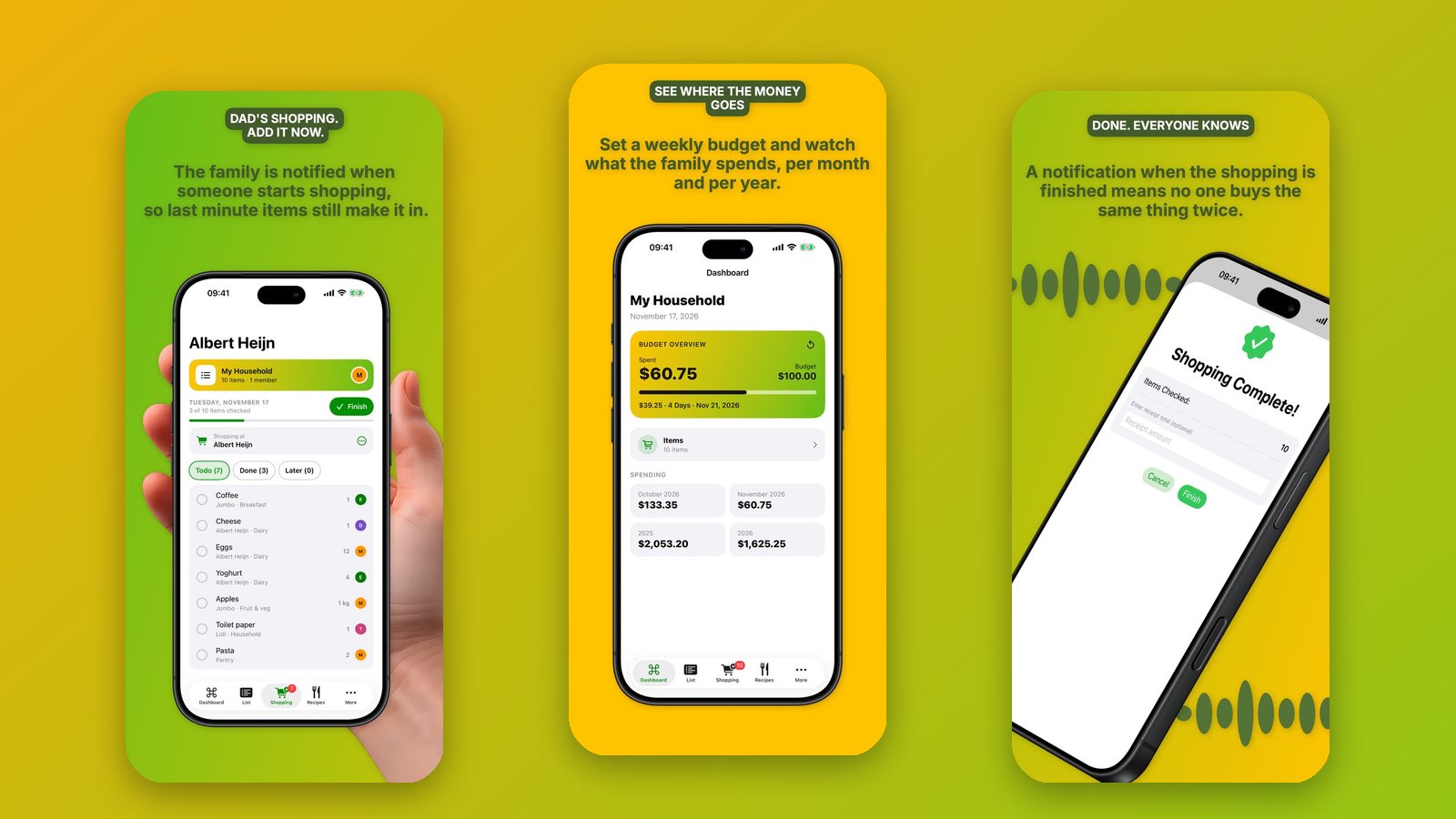
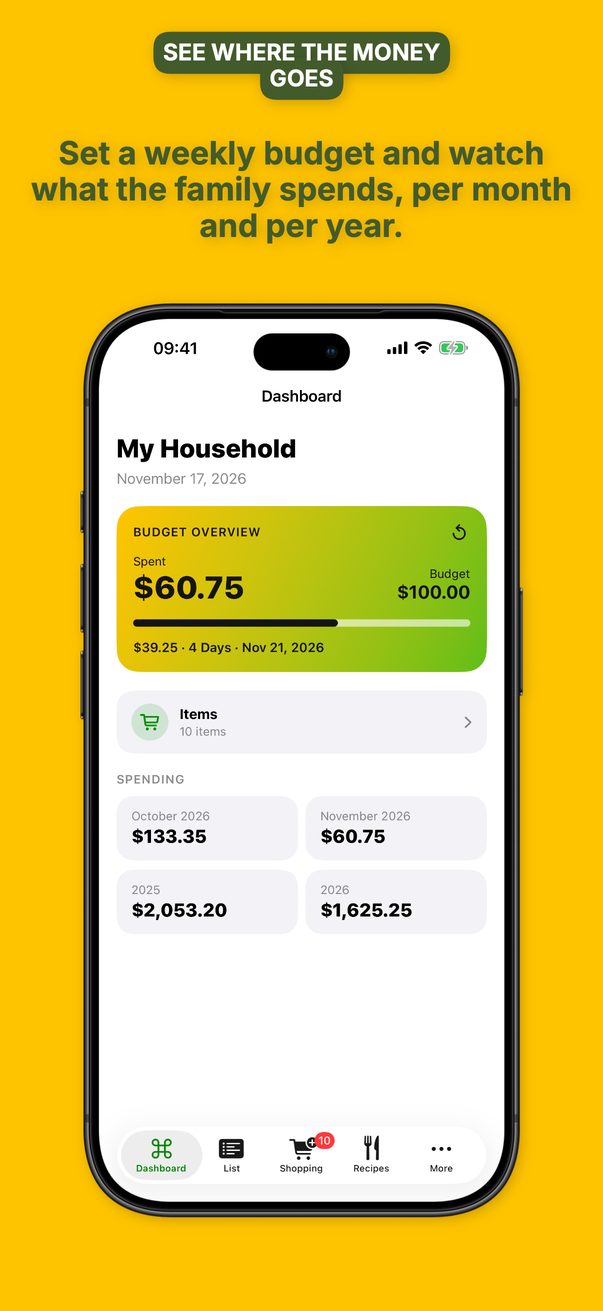
- A budget and a period. You set a budget and the period it covers, and Tjatjie keeps a running total of what you have spent against it.
- Recording at the end of the trip. When you finish a shopping trip, you can type the receipt total or scan the receipt to add the prices to your budget. There is a switch for this in Settings.
- Receipt scanning. Take a photo of the receipt and Tjatjie can pull the items and prices off it. It can use AI (OpenAI) to read the receipt. That is optional, a limited number of AI scans is included, and you can always review and correct the items or type them in by hand.
- Charts per month and per year. The prices roll into monthly and yearly comparison charts, so you can see where the grocery money goes and where the same shop costs more one month than another.
- The budget at a glance. A home-screen widget shows your budget without opening the app.
- One list for the household. Everyone you invite adds items from their own device, each item shows who added it, and the others get a notification when someone adds an item, starts shopping or finishes.
- From recipe to list. One tap adds a recipe’s ingredients to the shopping list, and you can find recipes that use what is already on your list.
Where it does not fit: Tjatjie covers groceries, not your whole household budget, so it does not replace a budgeting app that reads your bank account. It is not available on Android or the web. And the app is unlocked with a Tjatjie Pro subscription that you choose after installing. The App Store page has the details.
Frequently asked questions
How much should a family of four spend on groceries?
There is no single right amount: it depends on where you live, the ages of the children and how often you cook. In the United States the USDA publishes four food plans every month, from Thrifty to Liberal, with the cost of a healthy diet for a reference family of two adults and two children. Use those as a range to check your own spending against, and start your budget from what you actually spend.
How do I make a grocery budget for the first time?
Add up what you spent on groceries in the last four weeks, decide what counts as groceries, and turn the total into a weekly amount. Then plan the meals before you shop, record every trip, and review the numbers at the end of the month. The first month is for measuring, not for cutting.
Is a weekly or a monthly grocery budget better?
A weekly amount is easier to keep, because you get a fresh start every seven days and a bad week cannot use up the whole month. A monthly total is better for comparing over time, because months with five weekends and stock-up trips even out. Most households do best with a weekly amount and a monthly review.
Should toiletries and cleaning products be in the grocery budget?
Either choice works, as long as you make it once and keep to it. Counting everything on the supermarket receipt is the least work, because you never have to split a receipt. Keeping food separate tells you more about what you eat. What does not work is switching between the two.
Does eating out count as groceries?
No. Restaurants, takeaway and lunches bought at work are a separate category in most budgets, and statistics offices also report food at home and food away from home separately. Keep an eye on both, though: a week with a low grocery total and three takeaways was not a cheap week.
How do I stick to a grocery budget?
Know during the week how much is left, not only afterwards. Shop from a list, do one large trip and as few small ones as possible, and record each receipt on the day itself. When you go over, find out which trips caused it before you decide the budget was too low.
What is the easiest way to track grocery spending?
The easiest way is the one you will keep doing. A debit card used only for groceries needs no bookkeeping at all, and a note with the total of every trip takes ten seconds. Tracking each item with its price takes more effort, and in return shows which products and which stores make the bill high.
Which app tracks a grocery budget on iPhone together with the shopping list?
Tjatjie is a shared grocery list for iPhone, iPad and Mac with a budget built in. You set a budget and the period it covers, and after a shopping trip you type the receipt total or scan the receipt, so the prices are added to a running total. Monthly and yearly charts show where the grocery money goes, and a home-screen widget shows the budget at a glance. Tjatjie is unlocked with a Tjatjie Pro subscription and is not available on Android or the web.