Energy · Dynamic prices
Negative Electricity Prices: What They Mean for Your Bill and Your Solar Panels
A few hundred hours a year, the price of electricity drops below zero. Whether that saves you money or costs you money depends on your contract and on what is on your roof. Here is how it works and what to do with those hours.
By Nico Jansen, maker of Sibber··16 min read
🇳🇱 Lees dit artikel in het Nederlands →🇩🇪 Diesen Artikel auf Deutsch lesen →🇪🇸 Leer este artículo en español →🇵🇹 Ler este artigo em português (Portugal) →🇮🇹 Leggi questo articolo in italiano →🇧🇷 Ler este artigo em português (Brasil) →🇫🇷 Lire cet article en français →
The short answer
A negative electricity price means that on the wholesale market more power is produced than used, so sellers pay buyers to take it; it happens mostly around midday on sunny, windy days with low demand. On a dynamic contract those are the cheapest hours to use power, while taxes and grid charges usually keep your own price just above zero; if your solar feed-in follows the market, feeding in during those hours can cost you money.
What to do, in five steps:
The first time you see it, it looks like a mistake. A Sunday in May, the supplier’s app shows a row of bars hanging below the line, and the price says minus something. Electricity that costs less than nothing.
It is not a mistake, and it is no longer rare. With every year of new solar panels there are more of these hours, and with them two questions that come up in every household on a dynamic contract: do I get paid to run the washing machine now, and should I switch my solar panels off?
The honest answer to both is: it depends on your contract. This guide explains what a negative price is, why it happens, what it does to your bill and to your solar income, and how to use those hours without spending the afternoon watching a graph.
What is a negative electricity price?
A negative electricity price is a wholesale price below zero: for that hour or quarter-hour, whoever delivers power to the grid pays, and whoever takes it off the grid is paid. It is the market’s way of saying there is too much electricity at that moment.
The price in question is the day-ahead price, set the day before on power exchanges such as EPEX Spot and Nord Pool. It is quoted in euros per megawatt-hour. A price of −20 €/MWh is −2 cents per kilowatt-hour; the extreme −500 €/MWh is −50 cents per kilowatt-hour.
That wholesale price is what a dynamic contract passes on to you, hour by hour or quarter-hour by quarter-hour. On a fixed or variable contract the supplier absorbs it, and you see none of it. So the first thing to know is that negative prices are a market fact for everyone, but a bill fact only for people whose contract follows the market.
Why do electricity prices go below zero?
Prices go below zero when more electricity is produced than used and the producers who keep going would rather pay than stop. Electricity has to be used the moment it is made, so a surplus has to be priced away.
Four things push in that direction at the same time:
- Solar panels produce together. Every panel in a country peaks around the same hour. On a clear spring day the combined output at midday can exceed what the whole country uses.
- Many panels do not see the price. Most home systems feed in whatever they make, at a fixed rate or under net metering, so they keep producing when the market is negative. Older subsidy schemes pay producers per kWh regardless of the market price, which makes producing worth it even below zero.
- Some plants cannot stop for a few hours. Nuclear plants and some gas and coal units are slow or expensive to switch off and on again. Paying to keep running through a sunny lunchtime can be cheaper than a restart in the evening.
- Demand is low. At weekends and on public holidays offices and factories use less, and in spring there is little heating or cooling. The same sun meets fewer buyers.
Exports, pumped hydro and batteries soak up part of the surplus, but when neighbouring countries have the same sunny Sunday, there is nowhere for the power to go. That is why negative hours tend to appear in several countries at once.
How often are electricity prices negative?
Negative prices now occur a few hundred hours a year in the countries with the most solar and wind, and the number has risen every year. The International Energy Agency puts the share at around 6% of all hours in 2025 in France, Germany, the Netherlands and Spain.
| Country | Negative day-ahead hours | Source |
|---|---|---|
| Germany, 2024 | 457 hours | SMARD (Bundesnetzagentur) |
| Germany, 2025 | 573 hours, a record | SMARD (Bundesnetzagentur) |
| Netherlands, 2024 | about 458 hours | market analysts |
| Netherlands, 2025 | about 584 hours, a record | Montel |
| France, Germany, Netherlands, Spain, 2025 | about 6% of all hours | IEA, Electricity 2026 |
The counts differ a little between data providers, partly because the European market moved from hourly to quarter-hourly prices on 1 October 2025 and not everyone counts the same way. The trend is not in doubt.
Most negative hours are mild: a few euros per megawatt-hour below zero. The extremes are short. On 1 May 2026, a sunny public holiday, quarter-hour prices in several European countries fell to or close to the market floor of −500 €/MWh. Because prices came that close, the exchanges lowered the floor to −600 €/MWh from late May 2026, as their rules require.
When do negative prices happen?
Negative prices happen mostly between about 11:00 and 16:00 on sunny days from April to September, and most of all on weekends and public holidays. Windy nights can add a few, especially in the north.
| Situation | Chance of negative prices | Why |
|---|---|---|
| Sunny Sunday or holiday in spring | Highest | Peak solar, low demand, little heating |
| Sunny weekday in summer | Moderate, around midday | Peak solar, but offices and industry use more |
| Windy night with low demand | Possible | Wind keeps producing while most people sleep |
| Cloudy, still day | Very low | Little solar or wind, gas sets the price |
| Winter evening | Practically none | High demand, no sun |
You never have to guess on the day. Tomorrow’s prices are published around 13:00 Central European Time, so a negative block is visible about a day ahead. Spring is often the peak: the sun is already strong, panels work well in cool weather, and there is little heating or air conditioning to use the surplus. In Germany, April 2026 alone had 123 negative hours.
Do you get paid to use electricity when the price is negative?
Usually not quite: only the market part of your price is negative, and taxes, grid charges and the supplier’s fee are added on top, so your total per kWh mostly stays just above zero. It is still the cheapest electricity you will buy all year.
Here is what a kilowatt-hour costs on a dynamic contract in a negative hour:
| Part of the price | In a negative hour |
|---|---|
| Market price | Negative, for example −1 to −5 cents per kWh |
| Supplier’s fee | Unchanged, a small amount per kWh or a monthly fee |
| Energy tax and levies | Unchanged, often the largest part of the price |
| Grid charges | Unchanged, or lower where grid charges vary by time of day |
| VAT | Depends on the country and on how the supplier calculates it |
In countries with high energy taxes, such as the Netherlands and Germany, a market price of −2 cents still leaves you paying something per kWh. Your total only drops below zero when the market is negative enough to outweigh the taxes and charges, which happens in the deepest hours of the year, not in a typical negative hour. How your supplier treats VAT on a negative market price varies, so the exact figure is in its app or on your invoice.
The useful way to look at it is the gap. If the evening costs 35 cents and the negative midday costs 8, every kilowatt-hour you move saves 27 cents. For an electric car that takes 30 kWh, that is real money in one afternoon. Whether the bar in the app is below the line matters less than how far it sits below the rest of your day.
What do negative prices mean for your solar panels?
For solar owners a negative price only matters if what you are paid for feeding in follows the market; then every kilowatt-hour you deliver in a negative hour costs you money instead of earning it. With a fixed feed-in tariff or full net metering, the market price does not reach you.
| Your situation | What a negative hour means | What to do |
|---|---|---|
| Fixed or variable contract with net metering | Nothing directly: what you feed in is offset against what you use | Leave the panels on |
| Fixed feed-in tariff (for example an older German EEG system) | You are still paid the fixed rate | Leave the panels on |
| Dynamic contract where feed-in is paid at the market price | Feeding in costs you the negative market price per kWh | Use the power yourself, or limit or switch off the inverter for the block |
| Supplier charges a fee for every kWh you feed in | The fee applies on top, also in negative hours | Use as much as you can yourself in those hours |
| New German system since 25 February 2025 with a smart meter | No feed-in payment during negative hours; the lost period is added to the end of the 20 years | Use the power yourself or store it |
Two countries show how fast this is changing. In Germany, the so-called solar peak law (Solarspitzengesetz) means new systems commissioned from 25 February 2025 receive no feed-in payment for hours with a negative exchange price, once they have a smart meter; the lost time is added at the end of the 20-year payment period. Existing systems are not affected. In the Netherlands, net metering (salderen) ends on 1 January 2027. From then on, every kilowatt-hour you feed in is paid at whatever your contract says, and on a dynamic contract that includes the negative hours.
The rules differ per country and per supplier and they change, so check yours. Look for the words feed-in tariff, feed-in fee, or how your supplier pays for “returned” power, and whether the price follows the hour.
Should you switch your solar panels off?
Switch your solar panels off, or limit them, only if feeding in costs you money in that hour and you cannot use the power yourself; otherwise leave them on. Using your own solar power is always the better option, because it replaces power you would otherwise buy.
Think about it in this order:
- Use it. Run the car charger, the boiler, the heat pump, the dryer and the dishwasher in the negative block. Every kilowatt-hour you use yourself is one you neither buy nor feed in at a loss.
- Store it. A home battery can charge from your panels, or from the grid at a negative price, and discharge in the evening peak.
- Limit it. Many inverters can cap the power fed into the grid, so you produce only what the house uses. That needs a smart meter reading or a current sensor and a setting in the inverter’s app; the installer can tell you whether yours supports it.
- Switch it off. If none of that is possible and feeding in costs money, switching the inverter off for the block avoids the cost. Use the inverter’s app or its switch; do not pull fuses or work on the wiring yourself.
Keep the size of the money in view. A typical home system feeding in 3 kWh during a block at −2 cents costs you 6 cents. On a day at −30 cents, it is close to a euro. The first is not worth climbing to the attic for; the second, on a dozen spring weekends, adds up.
What matters most is timing. A negative block has a start and an end. Switch off too early and you lose good production; switch back on too late and you lose the sunny afternoon after the block.
How to make the most of a negative block in 5 steps
Making the most of negative prices takes five steps: know your contract, check tomorrow’s prices, move the big loads, decide what the panels do, and set an alert for the start and the end. The first step you do once; the rest takes a minute on the days it matters.
1. Find out what you pay and what you get paid
Look up two things in your contract or your supplier’s app. First, the price you pay: one fixed price, or a price per hour or quarter-hour. Second, what you get for feeding in: net metering, a fixed rate, the market price, and whether there is a fee per kWh. Write both down. They decide everything that follows.
2. Check tomorrow’s prices after 13:00
Negative blocks are announced a day ahead. Pick a fixed moment in the afternoon and look at tomorrow, especially before a sunny weekend or a public holiday. Note when the block starts and ends and how deep it goes.
3. Move your big loads into the block
Start with whatever uses the most: the electric car, then hot water and heating, then the dryer, the dishwasher and the washing machine. A charger schedule and the delay timer on appliances do the work. Because the block falls in the middle of the day, you do not have to run anything while you sleep.
4. Decide what the solar panels do
Use the order from the previous section: use, store, limit, switch off. If your feed-in is fixed or netted, there is nothing to decide and the panels stay on.
5. Set an alert for the start and the end
The two moments are the minute the price drops below zero and the minute it comes back above. A notification for each means you switch things on and off on time, without checking the app every half hour on a Sunday.
What goes wrong on a negative day?
What goes wrong most often is acting on the market price alone, without knowing what your own contract does with it. These are the mistakes I see most.
| Mistake | What to do |
|---|---|
| Switching panels off on a fixed feed-in tariff or net metering | Check your contract first. If you are paid regardless, switching off loses you income. |
| Expecting to be paid for using power | Taxes and charges stay. Expect very cheap power, not income. |
| Comparing the bare market price with your all-in price | Market data sites show the price without taxes. Your supplier’s app shows what you pay. |
| Forgetting to switch the panels back on | Set an alert for the end of the block, not only for the start. |
| Running the dryer at night to chase a negative hour | Most negative hours are at midday. Fire services advise against running dryers unattended. |
| Looking only at negative hours | A price of 3 cents next to an evening of 35 is just as worth using. Look at the gap. |
Two alerts per negative block with Sibber
I built Sibber for Tibber customers who want to act on their prices without watching them. For negative prices it does exactly the last step above:
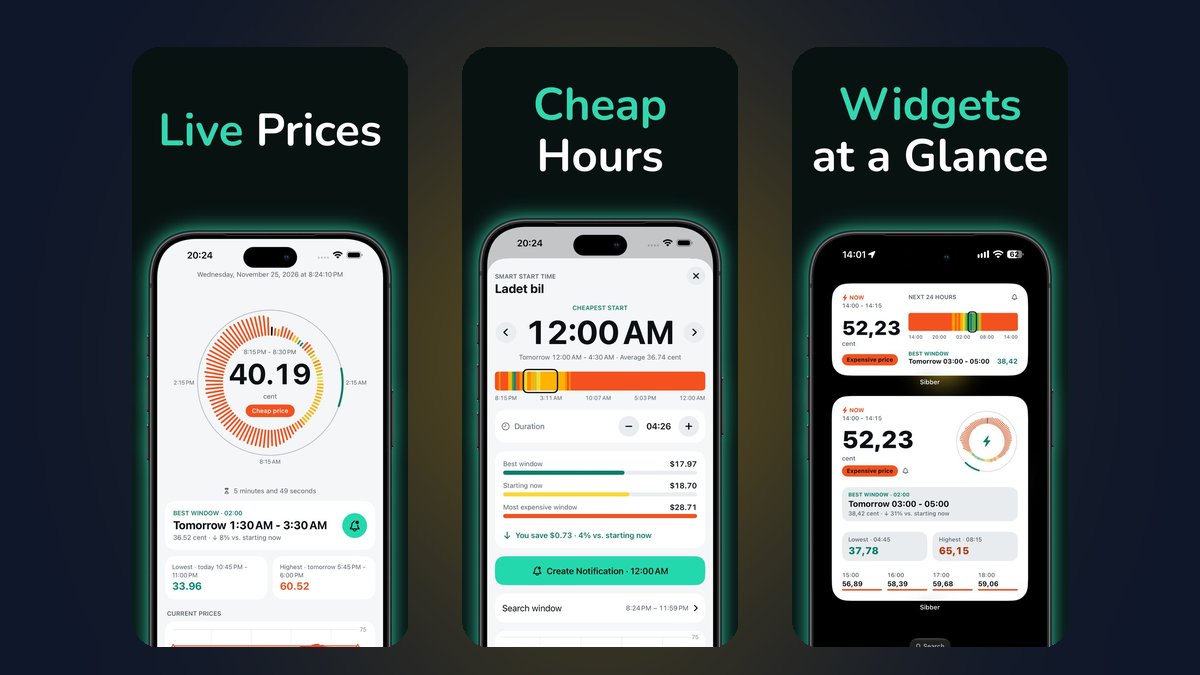
- Every negative block, today and tomorrow. Sibber finds every block of negative prices in the prices it has fetched from Tibber and can schedule two notifications per block: one the moment prices turn negative and one when they are back above zero.
- Once, or automatically. Tap the bolt icon in Notifications, or the banner on the price screen, to create them for the coming blocks. Or turn on the auto option in Settings, and Sibber creates them as soon as new prices arrive. You can write your own wording for both alerts, such as “Switch the inverter off”.
- A low line and a high line. Alongside the negative alerts, Sibber notifies you when the price drops below a low line or climbs above a high line you set, and you choose how often.
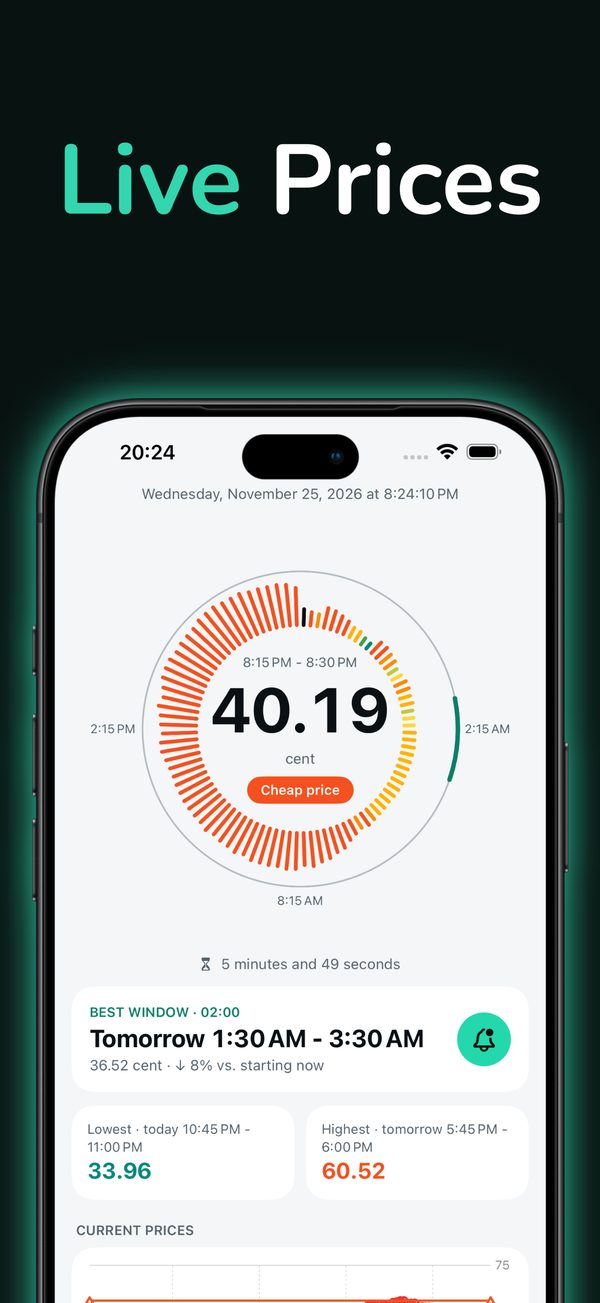
- The cheapest block for a job. Create an activity for the washing machine, the dishwasher or the car, say how long it runs and by when it should be done, and Sibber finds the cheapest block and reminds you to start. For the car it estimates the cost of the charge and what you save.
- Prices at a glance. The price clock shows the next 24 hours as a dial, and widgets on the Home Screen and Lock Screen, Control Center and the Apple Watch show the price without opening the app.
Where it does not fit: Sibber only works with a Tibber contract, because that is where it gets your prices. It does not switch your inverter for you; it tells you when. You connect it with your personal Tibber access token, and there is no separate Sibber account. Using the app takes a Pro subscription, billed through Apple. The interface is available in English, Dutch, German, French, Spanish, Swedish, Norwegian, Danish, Finnish and Polish.
Frequently asked questions
What does a negative electricity price mean?
It means that on the wholesale market, for that hour or quarter-hour, sellers pay buyers to take electricity. There is more power on offer than people use, and for some producers it is cheaper to keep producing and pay than to switch off.
Do I get paid to use electricity when prices are negative?
Only the market part of your price is negative. Taxes, grid charges and the supplier’s fee are added on top, so on most dynamic contracts the total you pay per kWh is still above zero, just very low. Your total only goes below zero when the market price is negative enough to outweigh those charges.
Why are electricity prices negative on sunny days?
Because millions of solar panels produce at the same time around midday, while demand is moderate, especially at weekends. Many of those panels do not react to the price, and some power plants cannot switch off for a few hours, so supply stays above demand and the price drops below zero.
How often are electricity prices negative?
Increasingly often. Germany had 457 hours with a negative day-ahead price in 2024 and 573 in 2025, according to its grid regulator’s data platform SMARD. In the Netherlands analysts counted around 584 negative hours in 2025. Most of them fall around midday between April and September.
Should I turn off my solar panels when prices are negative?
Only if feeding in costs you money in those hours, which is the case on many dynamic contracts where the feed-in price follows the market. If you are paid a fixed feed-in tariff or net metering still offsets what you feed in, switching off usually loses you money. Use the power yourself first; that always beats both.
How low can electricity prices go?
In the European day-ahead market the floor was −500 euros per megawatt-hour, which is −50 cents per kWh. After prices came close to it on 1 May 2026, the exchanges lowered the floor to −600 euros per megawatt-hour from late May 2026. Such extremes last a quarter-hour or two; most negative hours are only a few euros per megawatt-hour below zero.
Do negative prices help me on a fixed contract?
Not directly. On a fixed or variable contract you pay the same price per kWh at any hour, so negative market prices do not show up on your bill. They matter to you only if you have a contract with a price per hour, or a feed-in rate that follows the market.
Which iPhone app warns me about negative electricity prices?
For Tibber customers there is Sibber, an app for iPhone, iPad and Apple Watch. It finds every block of negative prices for today and tomorrow and can notify you when prices turn negative and again when they are back above zero. It also sends alerts for prices below or above a line you set and finds the cheapest hours for appliances and the car. Sibber only works with a Tibber contract, and using it takes a Pro subscription.