Energy · Dynamic prices
When Is Electricity Cheapest? Dynamic Prices Explained Hour by Hour
On a dynamic contract the price of a kilowatt-hour changes every hour, and the cheap moments are not where most people expect them. Here is when they fall, why, and how to move the car, the dishwasher and the laundry into them without watching a graph all day.
By Nico Jansen, maker of Sibber··15 min read
🇳🇱 Lees dit artikel in het Nederlands →🇩🇪 Diesen Artikel auf Deutsch lesen →🇫🇷 Lire cet article en français →🇪🇸 Leer este artículo en español →🇮🇹 Leggi questo articolo in italiano →🇵🇹 Ler este artigo em português (Portugal) →🇧🇷 Ler este artigo em português (Brasil) →
The short answer
Electricity is usually cheapest at night, roughly between 01:00 and 05:00, and on sunny days from spring to autumn also in the early afternoon, between about 11:00 and 15:00; it is usually most expensive in the early evening, between 17:00 and 21:00. The exact hours change every day with the wind, the sun and demand, but on a dynamic contract tomorrow’s prices are known from the early afternoon, so you can plan a day ahead.
The five steps:
You switched to a dynamic electricity contract, or you are thinking about it. The promise is simple: use power when it is cheap and your bill goes down. Then you open the supplier’s app and see a graph with twenty-four bars, or ninety-six, that looks different every day.
The first week you check it often. You start the dishwasher at the lowest bar and feel clever. By the third week you have stopped looking, the car charges the moment you come home at six, and that is the most expensive part of the day.
This guide is about closing that gap. It explains when electricity is cheap and why, what part of your bill moves with the hour, which appliances are worth the effort, and how to get from a graph you have to study to a message that says: now.
When is electricity cheapest during the day?
Electricity is cheapest when little is being used or a lot is being produced: in the middle of the night, and around midday when the sun is on millions of solar panels. It is most expensive when everyone needs power at once and the sun is gone, which is the early evening. The day has a shape that repeats, even though the height of the bars does not.
| Part of the day | Usual price level | Why |
|---|---|---|
| Night, 01:00–05:00 | Low | Demand is at its lowest. With wind at night, prices can drop far. |
| Morning, 06:00–09:00 | High | Households wake up and businesses start, before solar power produces much. |
| Midday, 11:00–15:00 | Low in spring and summer, average in winter | Solar panels produce the most. On sunny days this is often the cheapest part of the day. |
| Early evening, 17:00–21:00 | Highest | Cooking, heating, lighting and car charging start together as solar output falls away. |
| Late evening, 22:00–24:00 | Falling | Demand drops off towards the night. |
Three things move this pattern around.
- The season. In summer the midday dip is deep and the night is not always the cheapest part of the day any more. In winter the sun adds little, the midday dip nearly disappears, and the night is the cheap part.
- The weather. A windy day is cheap almost all day. A cold, still, grey week is expensive from morning to night, and no amount of planning finds a real bargain in it.
- The day of the week. At the weekend and on public holidays, offices and factories use less. The same sun and wind then meet less demand, which is why the lowest prices of the year tend to fall on sunny Sundays.
So “at night” is a good first answer and a poor rule. On a sunny day in May, the cheapest hour may be one o’clock in the afternoon. The pattern tells you where to look; the published prices tell you what is true for tomorrow.
Why does the price of electricity change every hour?
The price changes every hour because electricity is traded per hour, or per quarter-hour, on a wholesale market where supply and demand have to match at every moment. Electricity is hard to store in bulk, so what is used at 18:00 has to be produced at 18:00.
Each day, producers and suppliers place their bids for every period of the next day on a power exchange such as EPEX Spot or Nord Pool. This is called the day-ahead market. For each period the exchange lines up the offers from cheap to expensive: wind and solar first, because they have no fuel to pay for, then nuclear and hydro, and gas-fired plants last. The price for that period is set by the most expensive plant that is still needed to cover demand.
That one rule explains the whole shape of the day. When wind and sun cover almost everything, the last plant needed is a cheap one and the price is low. When demand peaks in the evening and gas plants have to start up, the price is set by gas, and it is high.
The swings have grown as more solar and wind have been built. Midday in summer now regularly has more power than buyers, and the evening still leans on gas. For a household that can choose when to use power, a bigger gap between cheap and expensive hours is what makes shifting worth it.
Which contract do you need to pay the hourly price?
You only pay the hourly price with a dynamic contract, where the supplier passes on the day-ahead market price for each hour or quarter-hour and a smart meter records what you used in that period. With any other contract, the wholesale price moves and your price does not.
| Contract | How the price is set | Does the hour matter? | Fits |
|---|---|---|---|
| Fixed | One price per kWh for one or more years | No | People who want certainty about the bill |
| Variable | One price per kWh that the supplier can change, often every few months | No | People who do not want to be tied in |
| Time-of-use (day/night, off-peak) | Two or three fixed prices for fixed blocks of the day | Yes, by the clock: the cheap hours are the same every day | Households with a night-time routine or a storage heater |
| Dynamic | The market price of each hour or quarter-hour, plus a fee, taxes and grid charges | Yes, and differently every day | Households with large loads they can move: an electric car, a heat pump, a home battery |
Dynamic contracts are common in the Nordic countries and available in most of the European Union; in the Netherlands and Germany they are offered by suppliers such as Tibber, and Great Britain has a half-hourly version in Octopus Agile. They all need a smart meter, because the supplier has to know not only how much you used this month but in which hours.
A dynamic contract is not a discount. It is a different deal: you get the market price, in both directions. Over a year that has often worked out well for people who can shift, and it can be uncomfortable in a winter when prices are high for weeks. If a high bill in January would be a real problem, a fixed contract is the honest choice.
How much of your bill moves with the hour?
Only the energy part of your price moves with the hour; taxes, grid charges and the supplier’s fee are added on top and are mostly the same at any time of day. That is why a market price of zero does not make your electricity cost nothing.
The price you pay for one kilowatt-hour on a dynamic contract is built up like this:
- The market price for that hour or quarter-hour. This is the part that changes, and the only part the graph in your app is about.
- The supplier’s fee, a small amount per kWh or a fixed amount per month for buying the power for you.
- Energy taxes and VAT, set by the government. In several countries these are the largest part of the price.
- Grid charges for the network operator. In some countries this is a fixed amount, in others a price per kWh that can itself differ by time of day.
Two things follow. First, check whether the prices in your app include taxes. Most supplier apps show the all-in price; websites with market data usually show the bare market price, which looks much lower. Second, the fixed parts do not shrink the difference between a cheap and an expensive hour. If the market price is 5 cents at 13:00 and 25 cents at 19:00, you save at least 20 cents on every kilowatt-hour you move, however much energy tax sits on top. Where VAT is charged on the market price as well, the difference on your bill is a little larger still.
When are tomorrow’s prices known?
Tomorrow’s prices are known in the early afternoon: the European day-ahead auction closes at 12:00 Central European Time and the results are published around 13:00. From that moment the price of every period of the next day is fixed and will not change.
This is the part that makes dynamic prices usable. You are not guessing. After lunch you can see the whole of tomorrow, and from then until midnight you can see up to thirty-five hours ahead. Suppliers show the new prices in their own apps shortly after the exchange publishes them.
Since 1 October 2025 the European day-ahead market trades in quarter-hours. A day now has 96 prices where it used to have 24. Some suppliers bill per quarter-hour, others still average them to an hourly price, so check which your contract uses. The difference shows most at the edges of the day: around sunrise and sunset the price can change a good deal within one hour.
Great Britain runs on its own clock. Octopus publishes the half-hourly Agile rates for the next day between 4pm and 8pm.
What are negative electricity prices?
A negative electricity price means that for that period the market pays buyers to take power, because there is more production than demand and switching plants off costs more than paying someone to use the electricity. It happens mostly around midday on sunny, windy days with low demand, such as a Sunday in May.
It is no longer rare. Germany counted 573 hours with a negative wholesale price in 2025, according to the market data platform of its grid regulator, and analysts at Montel counted 584 hours of negative day-ahead prices in the Netherlands. Both were records.
What it means for you depends on which side of the meter you are on:
- If you use power. The market part of your price is negative. Taxes and grid charges are still added, so whether your total price per kWh goes below zero depends on your country and on how negative the market is. Either way these are the cheapest hours you will get: the moment for the car, the laundry and the hot water.
- If you have solar panels. On many dynamic contracts the price you get for feeding in follows the market as well. In a negative hour you then pay to deliver your own solar power to the grid. The remedy is to use the power yourself in those hours, or to switch the inverter off until the price is back above zero.
For solar owners the two moments that matter are the start and the end of a negative block. You do not want to find out at four that the panels could have gone back on at two.
Which appliances are worth moving to cheap hours?
The appliances worth moving are the ones that use a lot of electricity and do not care when they run: first the electric car, then hot water and heating, then the dryer, the dishwasher and the washing machine. What you save is the number of kilowatt-hours multiplied by the price difference, so start with the biggest number.
| Load | Rough use per run | Can it wait? | Worth planning? |
|---|---|---|---|
| Electric car | 10 kWh for about 50–60 km; a large top-up is 30–50 kWh | Yes, usually all night | Very much. This is the largest movable load in most homes. |
| Hot water (boiler, heat pump) | Several kWh a day | Yes, a tank stores heat for hours | Yes, if the device has a timer or a smart control |
| Heat pump for heating | Large in winter, depends on the house | A little: a well-insulated house holds heat for a few hours | Yes, by heating slightly ahead of the evening peak |
| Tumble dryer | 1–2 kWh with a heat pump dryer, 3–4 kWh with an older model | Yes | Yes |
| Dishwasher | About 1 kWh | Yes, with the delay timer | A little per run, but it runs every day |
| Washing machine | 0.5–1 kWh | Yes, with the delay timer | A little per run |
| Oven, hob, kettle | 1–2 kWh for a meal | No, you eat when you eat | No |
| Fridge, freezer, lighting, router | Small and continuous | No | No |
The figures are rough and differ per appliance; the label or the manual has the real ones. The order is what counts. One night of charging the car in the right hours is worth more than a month of perfectly timed dishwasher runs. If you have no electric car, no heat pump and no home battery, a dynamic contract still works, but there is less to gain from planning.
One point about safety. Fire services generally advise against running a dryer or a washing machine while you sleep or while nobody is home. The cheap midday hours at the weekend are friendlier for those than three in the morning. A car on a properly installed charger is made to charge through the night.
How to plan around cheap hours in 5 steps
Planning around cheap hours takes five steps: know your contract, look at tomorrow’s prices, list what you can move, put the big loads in the cheapest block, and set alarms. The first three you do once. The last two become a routine of a minute a day.
1. Check which contract you have
Open your contract or your supplier’s app. If you see one price per kWh, the hour does not matter and you can stop here. If you see a day and a night rate, your cheap hours are fixed by the clock: look up the times and set the timers once. If you see a price per hour, you have a dynamic contract and the rest of these steps are for you.
2. Look at tomorrow’s prices in the afternoon
Pick one fixed moment after 13:00, such as the end of the working day, and look at tomorrow. You are looking for three things: the cheapest block, the most expensive block, and whether the difference between them is large. On a flat day there is nothing to plan. On a day with a deep dip, there is.
3. List what you can move
Go through the table above with your own house in mind. For each movable load, note two things: how long it runs, and by when it has to be done. The car needs four hours and has to be ready at 07:30. The dishwasher needs three hours and has to be empty before dinner. Those two numbers are all a plan needs.
4. Put the big loads in the cheapest block
Appliances run for hours, so the single cheapest hour is the wrong thing to look for. You want the cheapest run of consecutive hours that fits the load and ends before the deadline. Two cheap hours with an expensive one between them can cost more than three average hours in a row. Start with the car, because that is where the kilowatt-hours are.
5. Set alarms and stop checking
Now take yourself out of the loop. Use the delay timer on the dishwasher, the schedule in the charger or the car, and a notification on your phone for the things you have to start by hand. A good alarm tells you two things: the price is below the line you chose, or the cheap block for a particular job is about to start. Once that works, you can stop opening the graph.
What goes wrong when you chase cheap hours?
What goes wrong most often is effort in the wrong place: timing small loads to the minute, while the large ones run at six in the evening. These are the mistakes I see most, with what to do about each.
| Mistake | What to do |
|---|---|
| Plugging the car in on arrival, at the evening peak | Plug in when you come home, but let the charger or the car start in the cheap block. |
| Looking for the single cheapest hour | Look for the cheapest block that is as long as the job. |
| Assuming night is always cheapest | Check the day itself. In spring and summer the afternoon often wins. |
| Comparing the bare market price with your all-in price | Compare like with like. Market data sites leave taxes and grid charges out. |
| Leaving solar panels on through negative hours | On a dynamic feed-in price, use the power yourself or switch the inverter off for that block. |
| Checking the app all day | Decide your price lines once and let notifications do the watching. |
| Moving everything, including dinner | Move what does not care. A household that eats at ten to save a few cents will not keep it up. |
The last one matters more than it looks. The households that keep saving are the ones for whom it costs no thought. Two or three loads on a schedule, and an alarm for the exceptional hours, is a system you still use next year.
From price curve to a nudge with Sibber
I built Sibber for step five. It is a companion app for Tibber customers: it reads the prices for your home from your Tibber account and turns them into alerts and plans. This is how it handles the points above:
- A low line and a high line. Set a low-price and a high-price line in Settings. Sibber notifies you when the price drops below the low line or climbs above the high one, and you choose how often: once a day, once an hour, or not at all.
- The cheapest block for a job. Create an activity for the washing machine or the dishwasher, say how long it runs and by when it should be done, and Sibber finds the cheapest block of hours in that window and reminds you when to start. It shows how much cheaper that is than starting right now.
- Charging the car. Enter the battery level and capacity, and Sibber works out how long the charge takes and which hours are cheapest, with an estimate of the cost and of what you save. Owners of a supported V2C charger can let Sibber start and stop the charge.
- Negative prices. Sibber finds every block of negative prices for today and tomorrow and can notify you when prices turn negative and again when they are back above zero: the two moments for switching solar panels off and on.
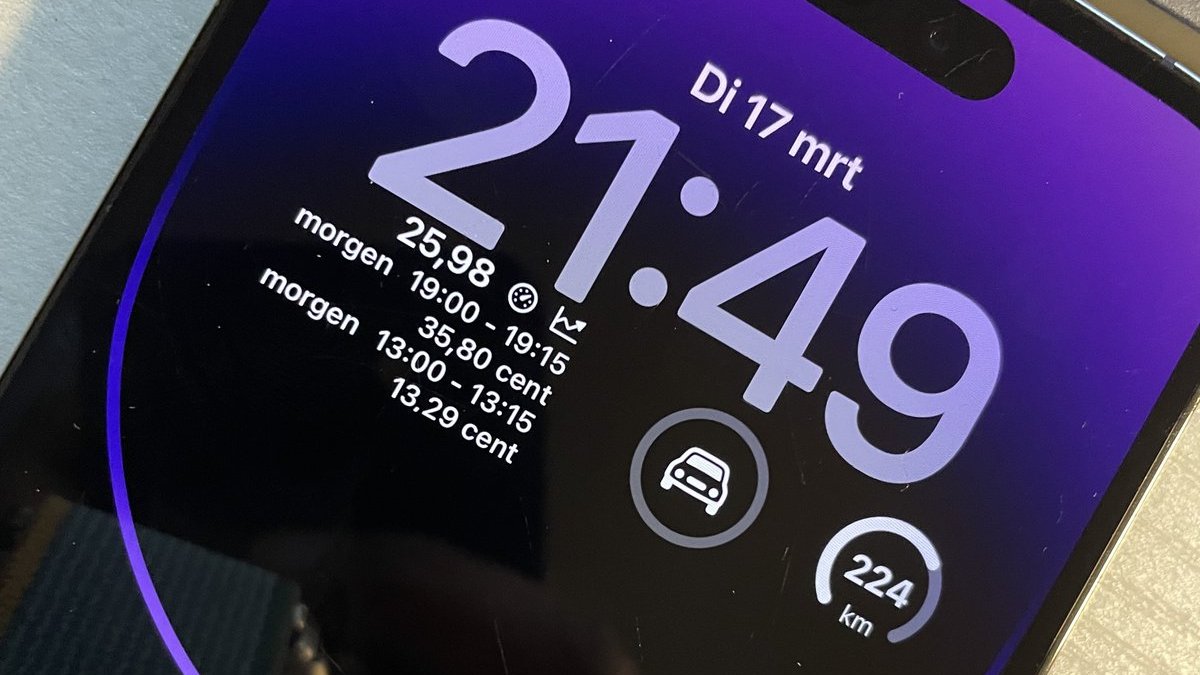
- Prices without opening the app. Widgets for the Home Screen and the Lock Screen show the current price and how the day looks. A control in Control Center sets an alarm for the cheapest upcoming slot, and on Apple Watch you can see the price on your wrist or ask Siri for it.
- Hours or quarter-hours. You can switch the display between hourly and 15-minute prices. Tomorrow’s prices appear once Tibber publishes them, typically around 13:00.
Where it does not fit: Sibber only works if you have a Tibber contract, because that is where it gets your prices. You connect it with your personal Tibber access token; there is no separate Sibber account. Using the app takes a Pro subscription, billed through Apple. The interface is available in English, Dutch, German, French, Spanish, Swedish, Norwegian, Danish, Finnish and Polish.

Frequently asked questions
What time of day is electricity cheapest?
On a dynamic contract, electricity is usually cheapest at night, roughly between 01:00 and 05:00, and on sunny days from spring to autumn also in the early afternoon, roughly between 11:00 and 15:00. It is usually most expensive in the early evening, between 17:00 and 21:00. The exact hours differ every day, so check the published prices for the day itself.
Is electricity cheaper at night?
Usually, yes: demand is low at night, so wholesale prices drop. On a dynamic contract you pay that lower price directly; on a day/night or off-peak tariff you pay a fixed lower rate in the hours your supplier or grid operator has set. On a single fixed rate, the hour makes no difference to your bill.
Is electricity cheaper at the weekend?
Often. Offices and factories use less power on Saturday and Sunday, so the same amount of wind and sun meets less demand and prices fall. Sunny, windy Sundays in spring and summer are when the lowest and the negative prices tend to occur.
When are tomorrow’s electricity prices published?
In most of Europe, the day-ahead auction closes at 12:00 Central European Time and the results follow around 13:00. Suppliers with dynamic contracts show the next day’s prices in their app shortly after. In Great Britain, Octopus publishes its Agile half-hourly rates between 4pm and 8pm.
Do I need a smart meter for dynamic electricity prices?
Yes. A dynamic contract bills what you used in each hour or quarter-hour at the price of that moment, and only a smart meter that records your consumption per interval can supply those readings to the supplier.
What does a negative electricity price mean for me?
A negative price means that the market price of electricity is below zero for that hour because there is more supply than demand. On a dynamic contract the market part of your price is then negative; taxes and grid charges still apply, so the total you pay per kWh may or may not drop below zero. If you have solar panels on a dynamic contract, feeding in during those hours can cost you money.
Is a dynamic electricity contract cheaper than a fixed one?
It can be, if you are able to move a large part of your consumption to cheap hours, for example by charging an electric car at night. You also carry the risk: when market prices rise for weeks, as they can in a cold, windless winter, your bill rises with them. A fixed contract costs you that flexibility and gives you certainty.
Which iPhone app tells me when electricity is cheap?
For Tibber customers there is Sibber, an app for iPhone, iPad and Apple Watch. It reads your prices from your Tibber account, notifies you when the price drops below or rises above a line you set, finds the cheapest block of hours for an appliance or for charging an electric car, and warns you when prices turn negative. Sibber only works with a Tibber contract, and using it takes a Pro subscription.