Household · Meal planning
How to Meal Plan for the Week: A Simple 7-Step System for Families
A meal plan answers “what’s for dinner?” once a week instead of every evening. Here is how to make one that survives a real week, how to turn it into a shopping list, and how to plan with everyone who eats at your table.
By Nico Jansen, maker of Tjatjie··18 min read
🇳🇱 Lees dit artikel in het Nederlands →🇩🇪 Diesen Artikel auf Deutsch lesen →🇫🇷 Lire cet article en français →🇪🇸 Leer este artículo en español →🇮🇹 Leggi questo articolo in italiano →🇵🇹 Ler este artigo em português (Portugal) →🇧🇷 Ler este artigo em português (Brasil) →
The short answer
To meal plan for the week, check your calendar and your fridge, choose five dinners for the seven evenings, and write your shopping list from the ingredients of those meals. Keep the plan where the whole household can see it, and treat it as a list of meals you can make this week, not a fixed timetable.
The seven steps:
It is half past five, everyone is hungry, and someone opens the fridge and asks what we are eating tonight. The answer depends on what is in there, and what is in there depends on what somebody remembered to buy. So there is a quick trip to the store, a bag with more in it than the one missing ingredient, and on Friday half a bag of spinach goes into the bin.
A meal plan fixes that loop at the start. You make the dinner decisions once, on a quiet moment, and the shopping follows from them. Most guides then hand you a printable template with seven boxes and three meals a day. That is where most first attempts stop: the plan is too full, nobody else in the house knows about it, and by Wednesday it no longer matches the week.
This guide is about a plan that holds: fewer meals than days, the list written straight from the recipes, and a plan the rest of the household can see. I build a shared grocery list app with recipes in it, so the step from plan to list is the one I have thought about most.
What is meal planning?
Meal planning is deciding in advance what you will eat in a coming period, usually a week, and buying the ingredients for those meals in one go. It has three parts: the meals, the shopping list that follows from them, and a place where the plan is written down.
Meal planning is not the same as meal prep. Planning is the decision and the shopping. Prep is cooking or chopping ahead: a pot of soup on Sunday, washed lettuce in a box, rice for three days. You can plan without ever prepping. Prepping without a plan is hard, because you do not know what you are prepping for.
It is also not a diet. A meal plan can hold pizza on Friday. What it changes is not what you eat but when you decide it: once, with the fridge open and the calendar in front of you, instead of every evening at the moment you are least able to think about it.
Why plan your meals for the week?
Planning meals for the week means fewer trips to the store, less food thrown away, and one decision a week instead of seven. The money is often the reason people start. The calm is usually the reason they keep going.
- The evening question is answered. Deciding what to eat at the end of a working day is when takeaway wins. With a plan, the decision was made on Saturday, and the ingredients are already in the house.
- Fewer trips. A list written from a plan is complete. The quick trip for one missing ingredient, and everything that comes home with it, mostly disappears.
- Less waste. The USDA estimates that 30 to 40 percent of the food supply in the United States is wasted, and a large share of that happens at home. Food bought for a meal that is actually cooked does not end up in the bin.
- More variety, not less. Without a plan, most households rotate the same four quick meals. With a plan, there is room for the recipe you saved three months ago.
- Anyone can cook. When the plan and the ingredients are there, the person who gets home first can start dinner. The knowledge is no longer in one head.
If saving money is your main goal, a plan is the best first step, and a budget is the second. I wrote a separate guide on how to make a grocery budget and stick to it.
How many meals should you plan?
Start with five dinners for seven evenings, and plan nothing else until that works for a few weeks. Dinner is the meal with the most ingredients, the most decisions and the most waste, so it is where a plan does the most.
| What you plan | Effort | Good for | Watch out for |
|---|---|---|---|
| Five dinners | Low | Every household, and every first attempt | Nothing: two open evenings absorb the surprises |
| Seven dinners | Medium | Households with a very regular week | One planned meal is often not cooked, and its fresh ingredients go to waste |
| Dinners and packed lunches | Medium | Work or school lunches from home | Plan lunches as leftovers from dinner, not as separate recipes |
| Every meal and snack | High | Specific diets, tight budgets, athletes | Breakfast is easier as a fixed list of staples than as a plan |
Why five and not seven? Because a real week has an evening where you eat out, get home late or still have half a pan of chili from yesterday. A plan with seven dinners has no room for that, and the meal that is skipped leaves behind exactly the ingredients that spoil fastest. Two open evenings are not a gap in the plan. They are what keeps it intact.
How to meal plan for the week in 7 steps
A weekly meal plan takes seven steps: check the week, check the house, choose how many meals, pick them, put the plan where everyone sees it, write the list, and stay flexible. The first time takes half an hour. After a month, with a set of meals you know, it takes ten minutes.
1. Look at the week ahead
Open the calendar before the cookbook. Which evenings is someone late, which evening is there football practice, who is coming to dinner, who is away? Mark each evening as quick, normal or relaxed. A quick evening gets a twenty-minute meal or leftovers. A relaxed one, usually on the weekend, is where the new recipe goes.
2. Check what is already in the house
Look in the fridge, then the freezer, then the cupboard. Write down what has to go first: the open cream, the vegetables that are getting soft, the chicken that has been in the freezer since spring. The first two dinners of the week are built around those. This is the step that prevents most waste, and the one most templates leave out.
3. Decide how many meals to plan
Count the evenings someone actually cooks at home, then take one off for leftovers. For most households that is five. If dinner often makes enough for two nights, plan four and write “leftovers” on the second evening.
4. Pick the meals
Three rules make this quick. Mostly familiar meals: a plan of five new recipes becomes takeaway by Wednesday. At most one new recipe a week, on a relaxed evening. And overlap: if one meal needs half a bunch of coriander, put another one with coriander in the same week.
If choosing is the hard part, give the weekdays a theme. You then pick one meal from a short category instead of one from everything you could cook:
| Day | Theme | Examples |
|---|---|---|
| Monday | Meatless | Vegetable curry, shakshuka, bean chili |
| Tuesday | Pasta | Pasta with tomato and tuna, pesto pasta, lasagna |
| Wednesday | Leftovers or freezer | Whatever is left, or a portion from the freezer |
| Thursday | Sheet pan or one pot | Chicken with roasted vegetables, fried rice |
| Friday | Fun night | Homemade pizza, tacos, burgers |
| Saturday | Something new | The recipe you saved last month |
| Sunday | Cook once, eat twice | Soup or stew, with a portion for Monday’s lunch |
5. Put the plan where everyone can see it
Write the days with the meals next to them where the household looks: a whiteboard on the fridge, a shared note, the list app you shop with. A plan that only lives in your head works until the evening someone else cooks. It also stops the question that undoes most plans: “Can we have something else tonight?” When everyone saw the plan on Saturday, there is less to negotiate on Tuesday.
6. Write the shopping list from the recipes
Go through the meals one by one and write down every ingredient. Cross off what you already have from step 2. Then add the things that are not dinner: breakfast, lunch, snacks, and the household items that ran out during the week. The next section is about doing this step well, because it is where a good plan most often goes wrong.
7. Prep once, and move meals when the week changes
After shopping, spend half an hour on what makes the week faster: wash and cut vegetables, cook a pot of rice or grains, make a sauce. Then let the plan bend. If Tuesday turns into a late evening, swap Tuesday and Thursday. The plan did its job when the ingredients are in the house; the order of the days is free. Only fresh fish and soft vegetables should keep their early place in the week.
What does a weekly meal plan look like?
A good weekly meal plan names five dinners, says which ingredients each one uses up, and leaves two evenings open. This is an example for a household of four, written on a Saturday with a fridge that still held half a bag of spinach, a pack of feta and some chicken thighs in the freezer:
| Day | Dinner | Uses up or sets up |
|---|---|---|
| Sunday | Spinach and feta pasta | Uses the spinach and feta from last week |
| Monday | Chicken and vegetable tray bake | Uses the chicken from the freezer; cook extra for Tuesday’s wraps |
| Tuesday | Chicken wraps (quick evening) | Leftover chicken from Monday |
| Wednesday | Open | Leftovers, or eggs on toast |
| Thursday | Lentil soup | Make a double batch; freeze half |
| Friday | Homemade pizza | The rest of the vegetables from Monday |
| Saturday | Open | Dinner out, or the soup from the freezer |
Notice what the plan does. Sunday uses what would otherwise be thrown away. Monday cooks once for two evenings. Thursday fills the freezer for a later week. And two evenings carry no ingredients at all, so if they get filled by a dinner out, nothing goes to waste.
Keep your plans. After four or five weeks you have a list of meals that worked in your household, and planning becomes picking from that list. Many families end up rotating a few weeks of plans and only adding one new recipe at a time.
How do you turn a meal plan into a shopping list?
You turn a meal plan into a shopping list by writing down the ingredients of every planned meal, removing what is already in the house, and adding the rest to the one list the household shops from. It sounds mechanical, and it is, which is exactly why it goes wrong when it is done from memory.
The usual mistakes, and how to avoid them:
- Writing the list from memory. “Lasagna” on the plan becomes “mince, pasta sheets” on the list, and the ricotta is forgotten. Work from the recipe, ingredient by ingredient.
- Not checking the house. The third jar of cumin in the cupboard comes from this step being skipped. Cross off what you have before you shop.
- Two lists. The meal plan list on the fridge and the other list on a phone. Whoever shops has one of the two. Put the meal ingredients on the same list as everything else.
- Quantities missing. “Tomatoes” is not enough when two meals need them. Add up the amount, or write down how many.
- A list in recipe order. Sort it the way you walk through the store, so you do not backtrack from the dairy aisle to vegetables three times.
This is the step a recipe app or a list app can do for you, and it is the step I wanted to stop doing by hand. When the recipes are saved, adding their ingredients to the list is a tap instead of ten minutes with a pen. If the list is also shared, the person who shops has the ingredients of the whole plan, wherever they are.
How do you plan meals with the whole household?
Meal planning works in a household when everyone has a say in the meals, the plan is visible to all, and whoever shops works from the same list. A plan made by one person for everyone else is a plan that one person defends all week.
- Everyone picks one. Let each person choose one dinner a week, children included. A child who chose Thursday’s tacos eats Thursday’s tacos.
- Build meals from parts. Tacos, rice bowls, wraps and pasta with the sauce on the side let a picky eater skip the part they do not like without a separate meal.
- Keep a fallback. One simple meal that everyone always eats, with the ingredients always in the house. It saves the evening a new recipe fails.
- Split cooking from planning. The person who plans does not have to cook every meal. With the plan on the fridge and the ingredients in the house, whoever is home first can start.
- One list for everyone. If someone notices on Wednesday that the milk is gone, it goes on the same list the meal ingredients are on. I wrote a separate guide on how to share a grocery list with your family.
Ten minutes at the table on Saturday works better than a plan that appears on the fridge. Ask what everyone wants this week, check the calendar together, and the plan is half made before anyone opens a recipe.
How long do leftovers and prepped meals keep?
Cooked leftovers keep 3 to 4 days in the refrigerator, according to the USDA, so meals cooked ahead for later in the week belong in the freezer. That rule decides how far ahead you can cook.
| Situation | Guideline |
|---|---|
| Cooked leftovers in the fridge | Eat within 3 to 4 days |
| Cooked leftovers in the freezer | Safe as long as frozen; best quality within about 3 to 4 months |
| Thawed leftovers (thawed in the fridge) | Eat within 3 to 4 days |
| Reheating | Until steaming hot, to 165 °F (74 °C) |
| Cooling before storing | Into the fridge within 2 hours, in shallow containers |
For planning, this means Sunday’s cooking covers Sunday to Wednesday. Something you want to eat on Friday is frozen on Sunday and moved to the fridge on Thursday. You cannot tell by smell or look whether leftovers are still safe, so go by the days, and label containers with the date. The USDA page on leftovers and food safety has the details.
Why do meal plans fail?
Meal plans fail because they are too full, too ambitious or invisible to the rest of the household, not because the people who make them lack discipline. These are the usual causes, and what helps against each:
| What goes wrong | What helps |
|---|---|
| Seven planned dinners, a week that has room for five | Plan five, leave two evenings open. |
| Five new recipes in one week | At most one new recipe, on a relaxed evening. |
| The plan ignores the calendar | Check the week first, and give busy evenings a quick meal. |
| Ingredients are missing on the evening itself | Write the list from the recipes, not from memory. |
| Only one person knows the plan | Put it where everyone looks, and plan together. |
| Half-used ingredients spoil | Let meals overlap in ingredients, and plan the next week around leftovers. |
| One missed evening and the plan is dropped | Swap days freely. The plan is a list of meals, not a schedule. |
The last one matters most. A week rarely goes as planned, and people who treat the plan as a timetable give it up the first time Tuesday goes wrong. People who treat it as “the five dinners we have the ingredients for” keep it for years.
Paper, spreadsheet or app: where should the plan live?
The plan should live where the household already looks and where the shopping list is, so that the step from meal to list takes as little copying as possible. Each option has its strong side:
| Tool | Strong side | Weak side |
|---|---|---|
| Whiteboard or paper on the fridge | Everyone sees it every day, no setup | Not with you in the store; the list is copied by hand |
| Printable template or planner | Structure, and nice to fill in | Same as paper, and often too many boxes to fill |
| Spreadsheet | Keeps old plans to rotate, easy to copy | Rarely opened on a phone, no link to the list |
| Shared note or Reminders list | On every phone in the household | Ingredients are typed over from the recipe |
| Meal planning app with a calendar | A plan per day, often with nutrition | Often a separate list from the one the household uses |
| Grocery list app with recipes | Recipe ingredients go straight to the shared list | The days of the week are up to you |
There is no wrong choice here. A whiteboard with five meals and a shared list on everyone’s phone is a perfectly good system. What to avoid is a plan in one place and the ingredients in another, copied over by the one person who knows both.
From recipe to shared list with Tjatjie
I built Tjatjie as the grocery list for our own household, and the recipes went in because the question “what are we eating?” always ends on the shopping list. It is a shared grocery list for iPhone, iPad and Mac, and this is what it does for the steps above:
- Recipes in one place. Type a recipe in by hand, paste a link to a recipe website, or take a photo of a recipe from a cookbook or a card, and Tjatjie brings in the ingredients. A recipe in another language can be translated.
- From recipe to list in one tap. Pick what you are cooking and one tap adds the ingredients to your shopping list. That is step 6 without the pen.
- Recipes from what is on the list. You can find recipes that use what is already on your list, which helps when the list came first.
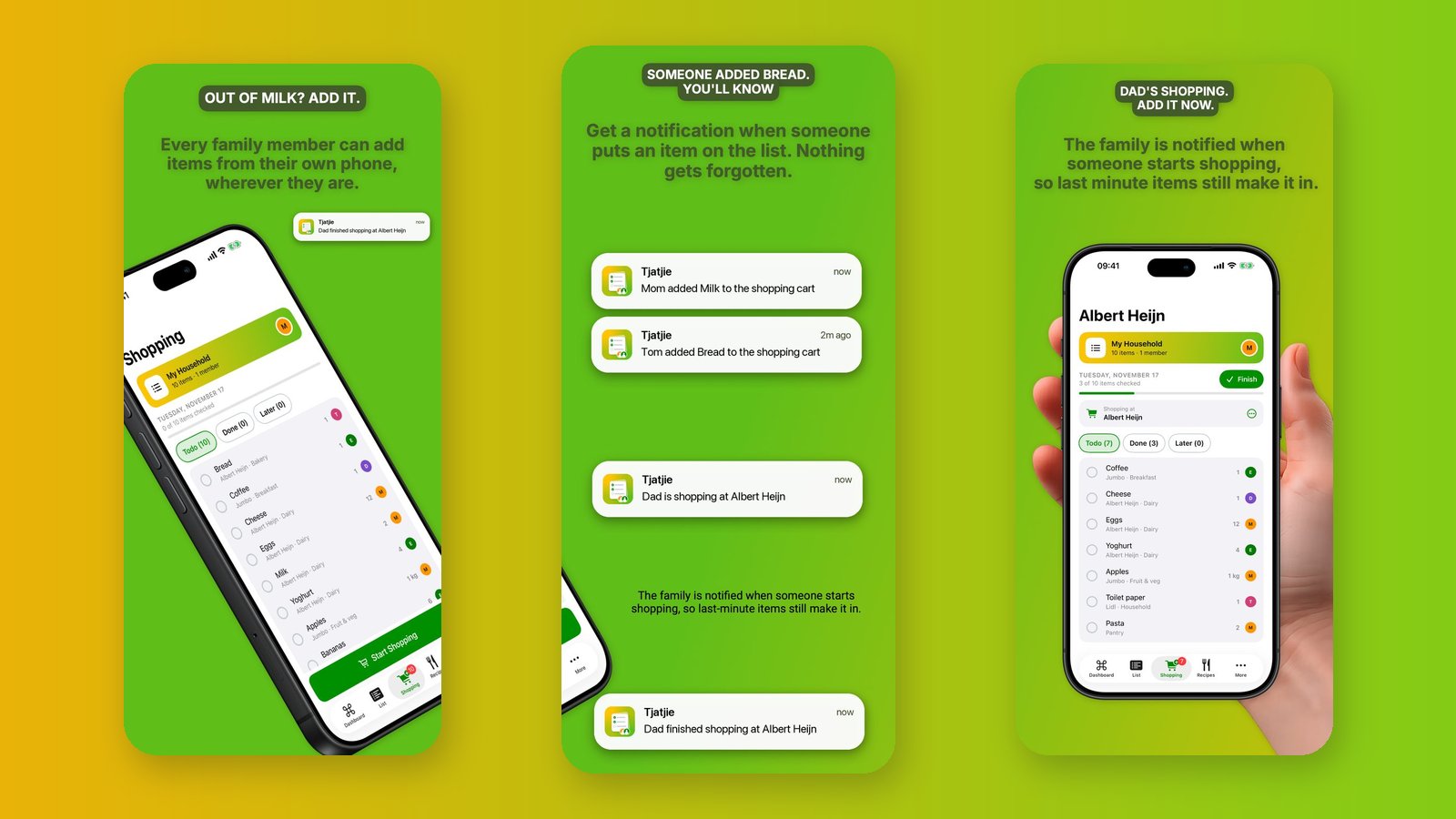
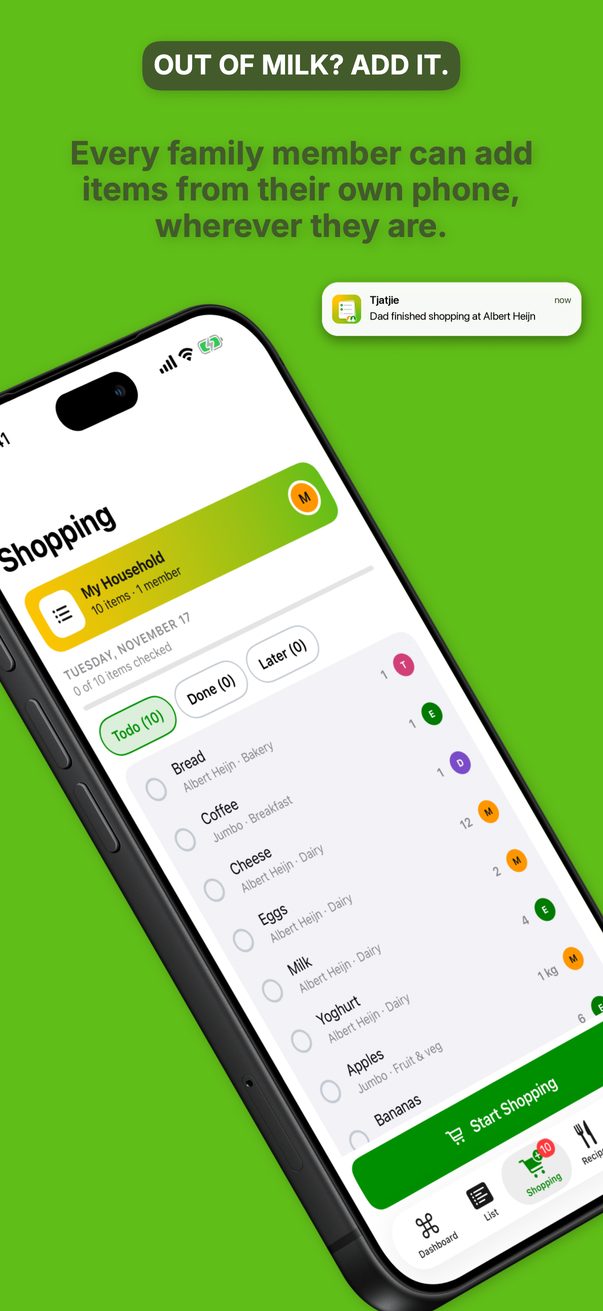
- One list for the household. Everyone you invite adds items from their own device, each item shows who added it, and the others get a notification when someone adds an item, starts shopping or finishes.
- In the store. Order the list by your route through the shop, give items a quantity, a note or a photo, and keep checking items off when the signal is bad: the list works offline.
Where it does not fit: Tjatjie has no meal calendar, so the days of the week stay on the fridge or wherever you keep them. It is not available on Android or the web. And the app is unlocked with a Tjatjie Pro subscription that you choose after installing. The App Store page has the details.
Frequently asked questions
How do I start meal planning as a beginner?
Start small: plan only dinners, only for one week, and only meals you already know how to make. Check the calendar and the fridge first, pick five dinners for seven evenings, and write the shopping list from those recipes. After two or three weeks you will have a set of meals to rotate, and planning takes a few minutes.
How many meals should I plan for a week?
Plan five dinners for seven evenings. One evening goes to leftovers and one to whatever the week brings: a dinner out, a late night, a meal that made enough for two days. Planning all seven usually means at least one meal is not cooked and its ingredients go to waste.
What is the best day to plan meals?
The day before your main shopping trip. Many households plan on the weekend and shop on Saturday or Sunday, but any fixed day works. What matters is that planning and shopping follow each other, so the list is complete when you walk into the store.
How do I meal plan for a family with picky eaters?
Let everyone pick one dinner a week, build meals from parts that can be served separately, such as tacos, bowls or pasta with the sauce on the side, and keep one simple fallback the children always eat. Introduce new food next to something familiar instead of as the whole meal.
Does meal planning save money?
It usually does, because a plan leads to a complete list, fewer trips to the store and less food thrown away. How much it saves depends on how you shopped before. If you want to see the effect in numbers, keep a grocery budget next to the plan.
What is the difference between meal planning and meal prep?
Meal planning is deciding what you will eat and buying the ingredients. Meal prep is preparing food in advance, from chopping vegetables to cooking whole meals for the week. You can plan without prepping; prepping without a plan is hard.
How long can I keep prepped meals in the fridge?
The USDA advises eating cooked leftovers within 3 to 4 days when they are kept in the refrigerator. For meals later in the week, freeze them and thaw them in the fridge the day before. Frozen food stays safe, but quality declines over time, so use frozen leftovers within a few months.
Which app turns recipes into a shared shopping list on iPhone?
Tjatjie is a shared grocery list for iPhone, iPad and Mac with recipes built in. You type a recipe in, or import it from a website link or a photo, and one tap adds its ingredients to the shopping list. Everyone in the household works on the same list from their own device and gets a notification when someone adds an item, starts shopping or finishes. Tjatjie has no meal calendar, is unlocked with a Tjatjie Pro subscription and is not available on Android or the web.