Genealogy · Family history
Questions to Ask Your Grandparents: How to Interview Relatives for Your Family Tree
The most valuable source for your family tree is not in an archive. It is the oldest generation of your own family. Here are 44 questions to ask them, how to record the conversation, and how to turn what you hear into names, dates and places you can check.
By Nico Jansen, maker of Gramps2··17 min read
🇳🇱 Lees dit artikel in het Nederlands →🇩🇪 Diesen Artikel auf Deutsch lesen →🇫🇷 Lire cet article en français →🇪🇸 Leer este artículo en español →🇮🇹 Leggi questo articolo in italiano →🇵🇹 Ler este artigo em português (Portugal) →🇧🇷 Ler este artigo em português (Brasil) →
The short answer
Ask your grandparents first for names, dates and places: who their parents and grandparents were, where they were born, married and buried, and who all the brothers and sisters were. Then ask open questions about their childhood, work, moves and the photos on the table, record the conversation with their permission, and check every fact against a record before you add the next generation.
The seven steps:
When my mother said we were family of someone, I could never quite picture how. Whose cousin? On which side? Years later my own children asked me the very same questions, and I noticed that I could only answer half of them.
That is how most family trees start: not with an archive, but with someone who knows. A grandmother who can name all eleven of her mother’s brothers and sisters. A great-uncle who remembers the village before everyone left. They carry knowledge that is written down nowhere, and the only way to get it is to sit down and ask.
This guide is about that conversation. It has the questions, sorted by theme, but also the part most question lists skip: how to prepare, how to record, which answers give you facts for your tree, and what to do when a story and a record disagree.

Why interview your relatives before you search the archives?
Interview your relatives first because they know the names, places and connections that tell you where to search, and because their memories, unlike the archives, will not wait. A birth register will still be there in twenty years. Your great-aunt’s memory of her grandparents may not.
Three reasons to start with people instead of records:
- One conversation reaches back 150 years. A grandmother born in 1945 may have known her own grandparents, born around 1880, and heard about theirs. Three or four generations, from one cup of coffee.
- Records need a starting point. To find a birth certificate you need a name, a rough date and a place. Without the village name your grandfather mentions in passing, you don’t know which archive to open.
- Some things are never written down. Who was close to whom, why a brother left and never came back, what a nickname meant, who is in the photo without a caption. No archive will tell you that.
If you haven’t started your tree yet, our guide on how to start a family tree covers the whole process. This article goes deep on its most urgent step.
How to interview your grandparents in 7 steps
A good family history interview is prepared, recorded, kept to one theme, and written up the same day. The questions matter less than you think; the preparation and the follow-up matter more.
1. Start with the oldest relatives and the family’s keeper
Go to the oldest generation first: grandparents, their brothers and sisters, their cousins. Then find the keeper. Every family has one person who always knew how everyone was related, who kept the photo albums, sent the Christmas cards or went to every funeral. That person is often not the oldest, and often knows the most.
Interview people one at a time when you can. In a group, the loudest voice tells the story, and the quiet aunt who knows the real version keeps it to herself.
2. Write down what you already know
Before the visit, put what you know on paper or in your tree: names, dates, places, who married whom. Every gap becomes a question. You will ask better questions, and you won’t spend half the visit on things you could have looked up. It also shows your grandmother that you have done your homework, which makes people more willing to tell.
3. Bring photos, documents and a chart
Questions open a little; pictures open a lot. Bring the old photo albums (or ask to see theirs), a certificate or a funeral card, and a printed family tree chart with the gaps visible. People who struggle with “tell me about your childhood” light up at “who is this man next to your mother?”. A chart on paper also invites them to correct it, which is exactly what you want.
4. Ask permission and record the conversation
Ask whether you may record, explain that it is for the family, and put your phone on the table. The Voice Memos app on an iPhone is all you need. On recent iOS versions it can also show a transcript of the recording, which makes it easier to find that one name later. Recording lets you listen instead of scribbling, catches names you would have misspelled, and keeps their voice for the grandchildren.
Always ask first. It is the decent thing to do, and in some countries and states the law requires everyone’s consent to record a conversation. If someone would rather not be recorded, take notes and read the key facts back at the end.
5. Ask one theme per visit, with open questions
Pick one theme per visit, such as childhood, the war years or the family’s moves, and keep it to about an hour. Older relatives tire, and the best memories often come in the second conversation, after they have had a week to think. Start with easy questions, ask what, where and who rather than yes-or-no questions, and follow the story when it goes somewhere you didn’t plan. Let silences last. The answer often comes after the pause.
6. Write it down the same day
Within a day, go through your recording or notes and write down every name, date and place you heard, plus who told you and when (“told by Grandma, 14 November 2026”). Add the people to your family tree, and put the stories in a note with the person they belong to. A recording you never listen to again is not research; a name in your tree with a note is.
7. Check the stories against records
Treat every answer as a strong lead, not as proof. Look up the birth, marriage and death records for the names and places you were given. When the record agrees, you have a fact. When it disagrees, you have something interesting, which we come back to below. And take what you found back to the next visit: “I found your grandfather’s marriage record, did you know he married twice?” is the best follow-up question there is.
Questions to ask your grandparents, by theme
The best questions to ask your grandparents start with names, dates and places and then move to the stories around them: home, work, moves, love, hard times and the objects in the house. You won’t get through all 44 in one visit, and you shouldn’t try. Pick a theme, print the list, and let the conversation go where it wants.
Parents, grandparents and the names
The backbone of your tree. Ask these first, and ask how every name is spelled.
- What were your parents’ full names? And your mother’s maiden name?
- When and where were your parents born?
- What were your grandparents’ names, and did you know them? What were they like?
- Who were your brothers and sisters, in order? Were there children who died young?
- Did anyone go by a nickname, a middle name or a different spelling?
- Were you named after someone? Who chose your name?
- Where and when did your parents marry? Was either of them married before?
- Where are your parents and grandparents buried?
Childhood and home
Easy to answer and full of places. Good questions to start any visit with.
- Where were you born, and in which house did you grow up? Can you draw the floor plan?
- What did the street and the neighbourhood look like? Who lived next door?
- Which school did you go to? Do you remember a teacher?
- What did a normal day look like when you were ten?
- What did you eat on an ordinary day, and what on a Sunday?
- What did you get into trouble for?
Places, moves and migration
Every move leaves a record somewhere. These answers tell you where to search.
- Where did the family come from originally? Who told you that?
- When did the family move, where to, and why?
- Did anyone emigrate? Where to, and did they stay in touch?
- Do you remember the journey? How did you travel, and what did you take?
- Which places did the family call home, and which did they leave behind?
Work and daily life
Occupations appear in almost every record, which makes them handy for telling two people with the same name apart.
- What did your father and mother do for work? And your grandparents?
- What was your first job, and what did you earn?
- Did anyone have a shop, a farm or a trade that passed down the family?
- Was money tight? How did the family get by?
- Did anyone serve in the military? Where, and in which unit?
Big events and hard times
Ask gently, and let them decide how much to tell. More on that below.
- What do you remember of the war, or of the big events of your youth?
- Was anyone in the family lost, injured or separated in those years?
- Was there a time the family had to start over?
- Who in the family had a hard life that nobody talks about any more?
Love, marriage and children
Marriages give you dates, places and a whole new branch of in-laws.
- How did you meet your husband or wife? What did your parents think?
- What was your wedding day like? Who was there?
- Where did you live when you were first married?
- What do you remember of the day your children were born?
- Who were the godparents or witnesses? (They were often relatives.)
Photos, papers and objects
This is where you find the family archive, or learn who has it.
- Who is in this photo? Where and when was it taken?
- Is there a family bible, a box of papers or old letters somewhere?
- Which object in this house has a story? Where did it come from?
- Has anyone in the family already done a family tree?
- Who else should I ask? Who knows more about this branch?
Traditions, stories and looking back
The answers you will treasure most, and the ones your children will want to hear.
- Which holidays and traditions did your family keep? Which recipes?
- What are the classic family stories, the ones told at every birthday?
- Who in the family were you closest to, and why?
- What are you proudest of?
- What was different about the world you grew up in?
- What do you want your great-grandchildren to know about you?
Want more? Oral history projects publish their own lists. StoryCorps, the American oral history project, has a Great Questions list sorted by theme, which is good for the life-story side of the conversation.
Which answers become facts in your family tree?
The answers that become facts in your family tree are full names, dates and places of birth, marriage and death, and who was the child of whom; each of them points to a record you can check. The stories give your tree life. These answers give it structure.
| Ask | What it gives your tree | Where to check it |
|---|---|---|
| What were your parents’ full names, and your mother’s maiden name? | Two people, and the surname of a new branch | Birth and marriage records |
| When and where were you, and your parents, born? | Dates and places of birth | Birth registers, church baptism records |
| Where and when did your parents marry? | A marriage date and place | Marriage records, newspaper notices |
| Who were all the brothers and sisters, including those who died young? | The complete family, in order | Birth and death registers, census returns |
| Where did the family live, and when did they move? | Places of residence and migration | Census returns, population registers, passenger lists |
| What did your father and grandfather do for work? | Occupations, which tell same-named people apart | Census returns, civil records, military files |
| Where are your parents and grandparents buried? | Places of death and burial | Death records, cemetery and grave records |
Always ask how a name is spelled, and whether it was ever spelled differently. Older records were written down by a clerk who heard the name, so the same family can appear as Jansen, Janssen and Janszen within one village. Knowing the variants saves you hours of searching.
How do you ask about difficult subjects?
Ask about difficult subjects gently and late, let your relative decide how much to tell, and accept “I’d rather not” as a full answer. War, poverty, a child who died, a divorce, an adoption, a father nobody mentions: these are often the stories that shaped the family most, and the hardest to tell.
- Don’t open with them. Start with childhood and work. Trust builds during the conversation, and a hard subject often comes up by itself in a later visit.
- Ask about the time, not the wound. “What was daily life like during the war?” is easier to answer than “what happened to your brother?”, and often leads to the same story.
- Offer to stop the recording. Some things people will only say off the record. Respect that, and don’t write it in a shared tree without asking.
- Think before you share. A family tree can tell someone something nobody has told them yet. Some facts about living people belong in your notes, not in the tree the whole family sees.
What if a family story doesn’t match the records?
When a family story and a record disagree, write down both, note where each came from, and look for a third source before you decide. Neither memory nor paper is always right: clerks made mistakes too.
Memory tends to bend in predictable ways. Dates shift by a few years. Two people with the same name merge into one. Events move closer to the teller (“my grandfather” turns out to be his father). And some stories are told so often that they become family fact while the record says otherwise.
A well-known example: many American families say their surname was changed at Ellis Island. Historians agree that didn’t happen there. Inspectors checked arrivals against passenger lists that had been written up at the port of departure, and they didn’t record new names. Families did change their names, but usually later, by their own choice, often around naturalization. The story is not a lie; it is a true change attached to the wrong moment, and the real records sit elsewhere.
Keep the story anyway. Write it in a note with the person: what was told, by whom, and what the record says. The disagreement itself is part of your family’s history, and the next researcher in the family will thank you for it.
Can you interview a relative by phone or video call?
Yes. A phone or video call works well for a family history interview, especially in short sessions with one theme each. Many families are spread across countries, and a weekly call can do more than one rushed visit a year.
- Send the photos ahead. Post or email copies of a few photos before the call, so you are both looking at the same picture.
- Record with consent. Many video-call services have a record button. Or put a second phone running Voice Memos next to your speaker. Ask first, as you would in person.
- Ask a local helper. A cousin or grandchild who lives nearby can hold up the album, read a date off a certificate, or set up the call.
- Share the tree instead of describing it. A relative who can see the tree on their own device can point at the gaps and fill them in themselves.
From conversation to family tree with Gramps2
I built Gramps2 because our own family research needed one place where everything comes together. After an interview, this is where the answers go:
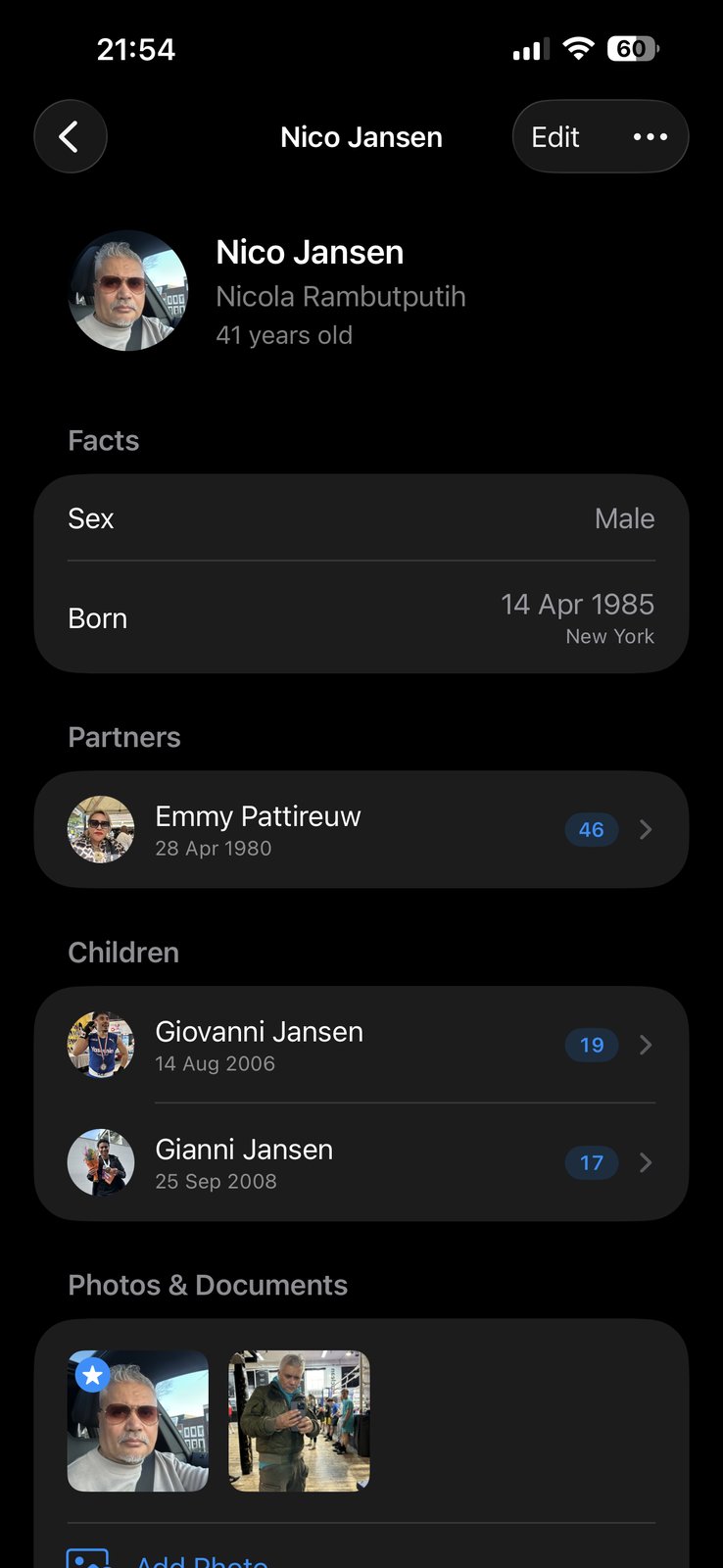
- Every person, in full. Add each relative with their birth and death dates and places, nickname, partners, children, and your notes from the conversation.
- Photos and documents with the right person. Attach the photos and scanned papers you were shown, and star one as the profile picture. It follows the person through the chart, lists and reminders.
- A chart to take along. Export the chart as an image or PDF, with every generation you choose, ready to print and lay on the table at the next visit. Or stream it to an Apple TV with AirPlay, so the whole family can follow from the couch.
- The family fills in the gaps. Share a tree through iCloud with the relatives you invite. Everyone sees the same tree and can edit it, and changes sync live, so a cousin can add what their mother remembered.
- The next research step. Choose Copy Summary on any person to put their family record on your clipboard, and paste it into an AI assistant to ask which archives to search next. Gramps2 has no AI built in and never sends your data to one.
- Private by design. Your trees live on your devices and sync through your own iCloud, with no account to create and no niApps servers.
Gramps2 runs on iPhone and iPad with iOS 18 or later and on the Mac with macOS 15 or later, in English, Dutch, German, French, Spanish, Italian and Brazilian Portuguese.
Frequently asked questions
What are good questions to ask your grandparents about family history?
Start with questions that give names, dates and places: what were your parents’ and grandparents’ full names, when and where were they born, where did they marry, where are they buried, and who were all the brothers and sisters, including those who died young. Then ask open questions that bring the stories: what was your childhood home like, why did the family move, what did your father do for work, and who is in this photo.
How long should a family history interview be?
About an hour is enough for one visit. Older relatives tire, and the best memories often come in the second or third conversation, when they have had time to think. Plan several short visits, each with one theme, rather than one long afternoon.
Should I record an interview with my grandparents?
Yes, if they agree. A voice recording on your phone is enough: you can listen instead of writing, you will catch names you would have misspelled, and you keep their voice for the family. Always ask first, and in some countries and states the law requires everyone’s consent to record a conversation.
How do I get my grandparents to open up?
Bring something to look at. Old photos, a wedding certificate, a map of the village or a printed family tree chart unlock memories that a direct question does not. Ask specific questions (what did the kitchen look like) instead of abstract ones (tell me about your childhood), listen more than you talk, and let silences last.
What if my grandparents don’t remember names or dates?
Ask about the things around the fact: the house, the school, the church, the neighbours, a photo. Approximate answers are useful too, such as before the war or when I was about ten. Then ask their brothers, sisters and cousins, and look for papers at home, like funeral cards, letters and certificates.
Are family stories reliable for genealogy?
They are reliable as leads, not as proof. The core of a family story is often true, while names, dates and the order of events drift over the years. Write down what you were told and who told you, and confirm each fact with a record before you build on it.
Who should I interview if my grandparents have passed away?
Their brothers, sisters and cousins, your parents and their cousins, and old family friends or neighbours. Each of them knew your grandparents from a different side. Also ask who has the photo albums and papers: the family’s archive usually sits with one person.
Which app can I use on iPhone to turn interview notes into a family tree?
Gramps2 is a family tree builder for iPhone, iPad and Mac. Add each person with their birth and death dates and places, nickname and your notes, attach photos and documents, and star one photo as their profile picture. You can share a tree through iCloud with the relatives you invite, so they can add what they know, and export the chart as an image or PDF to bring to your next visit.