Genealogy · Moluccan heritage
What Is Pela Gandong? The Moluccan Village Alliance Explained
Two Moluccans meet for the first time and within a minute they ask each other’s family name and village. The reason is pela: a promise between villages that is centuries old and still binds their grandchildren today.
By Nico Jansen, maker of Gramps2··15 min read
🇳🇱 Lees dit artikel in het Nederlands →🇩🇪 Diesen Artikel auf Deutsch lesen →🇫🇷 Lire cet article en français →🇪🇸 Leer este artículo en español →🇮🇹 Leggi questo articolo in italiano →🇵🇹 Ler este artigo em português (Portugal) →🇧🇷 Ler este artigo em português (Brasil) →
The short answer
Pela is a centuries-old alliance between two or more Moluccan villages (negeri), whose people count as brothers and sisters and promise to help, receive and respect each other. Pela gandong is the kind based on shared descent: the villages see their founders as children of one mother, and, like the pela keras, it traditionally forbids marriage between their members.
To find your own pela:
Gramps2 grew out of research into our own Moluccan and Indische families. Somewhere in that research you learn that a Moluccan family tree has two kinds of lines. One kind runs from parents to children, like every family tree. The other runs from village to village, and it decides who you treat as a brother or sister, whose house you may walk into as family, and sometimes whom you may not marry.
That second kind is pela. If you grew up in a Moluccan family in the Netherlands, you have heard the word at birthdays and funerals. If your grandparents came from Ambon, Saparua, Haruku, Nusalaut or Seram, the alliances of their villages are part of your family history, even if nobody ever wrote them down.
This guide explains what pela is, the three kinds, the rules, the difference between pela and gandong, and panas pela. Then it shows how to find the pela of your own family and record it, so the next generation doesn’t have to ask around again.

What is pela?
Pela is a traditional bond of brotherhood between two or more villages in the Central Moluccas, in which the inhabitants promise to help, protect and respect each other, generation after generation. It is found mainly on Ambon, on the Lease islands Haruku, Saparua and Nusalaut, and in parts of Seram.
A Moluccan village is called a negeri. Every Moluccan family name (fam) belongs to a negeri, and a negeri can have pela with villages on other islands, sometimes a day’s sailing away. The bond is not between individuals who chose each other. It was made by the ancestors, often centuries ago, and everyone born into the village inherits it.
Pela goes far beyond friendship. Pela partners are family without a shared bloodline: you help each other in hard times, you receive each other as relatives, and in most kinds of pela you do not marry each other. It is part of the adat, the body of Moluccan customs, norms and unwritten rules that governs village life.
What kinds of pela are there?
Three kinds are traditionally distinguished: pela keras, born from a major event and sealed with an oath; pela gandong, based on shared descent; and pela tempat sirih, a lighter bond of friendship. Names and customs differ from village to village, and some sources count only two kinds, but these three are the common division.
- Pela keras (hard pela, also called pela darah, blood pela). Born from a major event, usually linked to war: a battle neither side won, bloodshed, or extraordinary help from one village to another. The oath was traditionally sealed with blood mixed into palm wine, in which weapons were dipped, with a curse on anyone who breaks it.
- Pela gandong (also bungso). Based on descent. Gandong refers to the womb: the villages see themselves as children of the same mother, often because their founders were brothers. People of gandong villages are brothers and sisters.
- Pela tempat sirih (betel-box pela, also written pela tampa siri). Born from a smaller event: making peace after a quarrel, thanking another village for a favour, help with building a church, mosque or baileo (village meeting house), or trade. It is sealed by sharing betel rather than by a blood oath, and is less binding.
| Kind | How it began | Sealed with | Marriage between members |
|---|---|---|---|
| Pela keras | War, bloodshed or extraordinary help | Blood oath | Forbidden |
| Pela gandong | Shared ancestors, founders seen as siblings | Oath | Forbidden |
| Pela tempat sirih | Peace, a favour, help or trade | Sharing betel | Usually allowed |
What are the rules of pela?
Pela partners must help each other, receive each other as family, never cheat or insult each other, and, in a pela keras or pela gandong, never marry each other. The rules are not written in law. They are adat, passed on by the elders and kept alive by the villages themselves.
- No marriage. In a pela keras and a pela gandong, members of the allied villages count as brothers and sisters, so a marriage between them would be seen as incest, even when no blood relationship can be shown.
- Mutual help. Allied villages help each other with large works, such as building houses, churches, mosques and the baileo, and in times of crisis.
- Hospitality. When you visit your pela village, you are received as family and given food and a place to stay.
- Respect. You do not deceive, insult or harm your pela.
- Solidarity. At illness, deaths, weddings and natural disasters, pela partners stand by each other.
Behind the rules is the oath. According to tradition, the ancestors who swore it watch over it, and breaking the pela brings illness, misfortune or worse to the one who breaks it or to their family. That belief is why many Moluccans take the marriage rule seriously, even far from the village where the oath was sworn.
What is the difference between pela and gandong?
Pela comes from something the ancestors did, gandong from who the ancestors were: pela is a sworn alliance after an event, gandong a bond of shared descent. Gandong is often counted as a kind of pela, which is why you hear “pela gandong” as one phrase. In daily speech people also name it separately: “they are our pela” or “they are our gandong”.
| Pela | Gandong | |
|---|---|---|
| Origin | An event: war, rescue, help, peace | Shared descent from the same ancestors |
| Nature of the bond | Sworn brotherhood | Kinship according to tradition |
| Basis | An oath or a promise | Founders who were siblings |
| Marriage ban | Depends on the kind of pela | Yes, traditionally |
| Inherited by descendants | Yes | Yes |
For a genealogist the difference matters. A gandong story tells you something about where your village believes its founders came from: often a group of brothers who left one place and each founded a negeri. It is oral tradition, not a record you can check in an archive, but it is part of your family history all the same.
What is panas pela?
Panas pela, or bikin panas pela, means “heating up the pela”: a ceremony in which the allied villages meet to renew the existing alliance. It does not create a new bond. It keeps the old one alive, and it is meant to happen at least once while the youngest generation grows up, so they learn the story and their obligations.
The partners gather in one of the villages, sometimes for several days. Depending on the local adat, the ceremony includes:
- traditional dances, such as the cakalele war dance;
- music on the tifa drums and the totobuang gongs;
- the story of how the alliance began and of the shared ancestors;
- renewing the original oath;
- shared meals and religious services;
- passing the adat on to the young.
The ceremonies are still held. Rutong on Ambon and Rumahkay on Seram held one in 1974, documented in a photo series on Nunusaku, and again in Rutong in 2020. If your family’s village holds one, it is the best place there is to hear the alliance’s story from the people who keep it.
Pela between Christian and Muslim villages
Pela crosses religious lines: a Christian village can have a Muslim village as its pela or gandong, and the bond is older than the difference in faith. Allied villages help build each other’s churches and mosques. When a new church opened in Kariu on Haruku in 2017, Muslims from its gandong village Hualoy on Seram came to celebrate.
That gave pela a role in one of the darkest periods in Moluccan history. From January 1999 violence between Christians and Muslims tore through Ambon and the surrounding islands, and the Malino II agreement of February 2002 formally ended it. Researchers describe how pela and gandong ties helped restore relations afterwards, and how some allied villages refused to fight each other.
It was not a guarantee. A study of the gandong of Siri Sori notes that the Christian and the Muslim Siri Sori could not protect each other during the conflict. Pela was a bridge to rebuild on, not a wall that held everything back.
Examples of pela and gandong alliances
Every negeri has its own pela and gandong, and some alliances link three or four villages on different islands. A few well-known examples:
| Villages | Islands | Kind |
|---|---|---|
| Allang – Latuhalat | Ambon | Pela |
| Haria – Siri Sori Islam | Saparua | Pela gandong |
| Rutong – Rumahkay | Ambon and Seram | Pela gandong |
| Hutumuri – Siri Sori – Tamilouw | Ambon, Saparua and Seram | Gandong |
| Booi – Aboru – Kariu – Hualoy | Saparua, Haruku and Seram | Gandong |
The gandong of Hutumuri, Siri Sori and Tamilouw goes back, in the villages’ own story, to three brothers who each founded a village; Hutumuri is Christian, Tamilouw Muslim. Booi, Aboru, Kariu and Hualoy are Christian and Muslim villages on three islands.
These stories live in oral tradition, and villages do not always agree. The neighbouring village Latu, for example, has claimed the gandong with Booi, Aboru and Kariu that the villages’ own stories give to Hualoy. When you write down your village’s pela, write down who told you, too.
Pela in the Netherlands
The Moluccans who came to the Netherlands in 1951 brought their pela with them, and their children and grandchildren still keep it. In March 1951 the first ship arrived in Rotterdam, and in the months after about 12,500 people followed: soldiers of the former colonial army (KNIL) and their families. The stay was meant to last a few months. Most never went back.
In the Netherlands the bonds are kept up through kumpulan: associations of people from the same negeri. When a village in the Moluccas needs help, its kumpulan collects money. Pela partners meet at family events: baptisms, weddings and funerals.
The way pela is reckoned also changed. In the Moluccas a child belongs to the father’s clan and village, so traditionally the father’s pela is the one that counts. Many Moluccans in the Netherlands also recognize the pela of their mother, and sometimes of all four grandparents. That widens the circle of people you may not marry, and makes it more important to know your whole family tree.
It also explains the question at the start of this article. When two Moluccans meet and ask each other’s family name and village, they are checking whether a bond already exists between them, one made centuries before either of them was born.
How to find your pela in 5 steps
You find your pela by going from family names to villages, and from villages to their alliances. The sources are your relatives, the kumpulan, and one online database.
1. Collect the family names on every line
Write down the family name of your father, your mother and all four grandparents, and go further back where you can. Moluccan families in the Netherlands often count the pela of every line, so the mother’s side matters as much as the father’s. Ask the oldest relatives first: they are the people who know the names, and often the stories, that no archive holds. Our guide on how to start a family tree covers how to ask.
2. Find the negeri of each family name
Every Moluccan fam belongs to a negeri of origin. Usually the family knows: “we are from Waai”, “we are from Saparua”. Be precise, because an island has many villages with different pela. If nobody knows, Atlas Maluku lets you search by family name and by island or negeri. Some family names occur in more than one village, so check the result with your relatives.
3. Look up the pela and gandong of each negeri
Ask the elders first, then the kumpulan of the village: they know which villages they visit, and who comes to their gatherings. Atlas Maluku lists pela relationships per negeri as well, but its makers say themselves that the database is not complete, so a missing pela there does not mean the village has none.
4. Write down the type and the story
For each alliance, note the kind (pela keras, pela gandong or pela tempat sirih), the story of how it began as your family tells it, and who told you, with the date. Different villages tell the same story differently. Your source is part of the record.
5. Record it in your family tree
Put the negeri in the place fields of the people it belongs to, and the pela in their notes. Then it is there for the next generation, next to the names and dates, instead of in one person’s memory. Share the tree with the family, because an aunt in another city may know the story you are missing.
From family name to negeri to pela with Gramps2
I built Gramps2 for families like mine, where the answer to “how are we related?” is sometimes a bloodline and sometimes a village. Gramps2 has no special field for pela, and doesn’t need one. This is how the steps above fit in:
- The negeri as a place. Every person has a birth and a death with dates and places. Put the negeri there for the people born in it, so the village of each family name is visible in the tree.
- The pela in the notes. Write the village’s pela and gandong, the kind, the story and who told you in the person’s notes. Attach photos and documents too: a picture of a panas pela, a letter, a scanned family document.
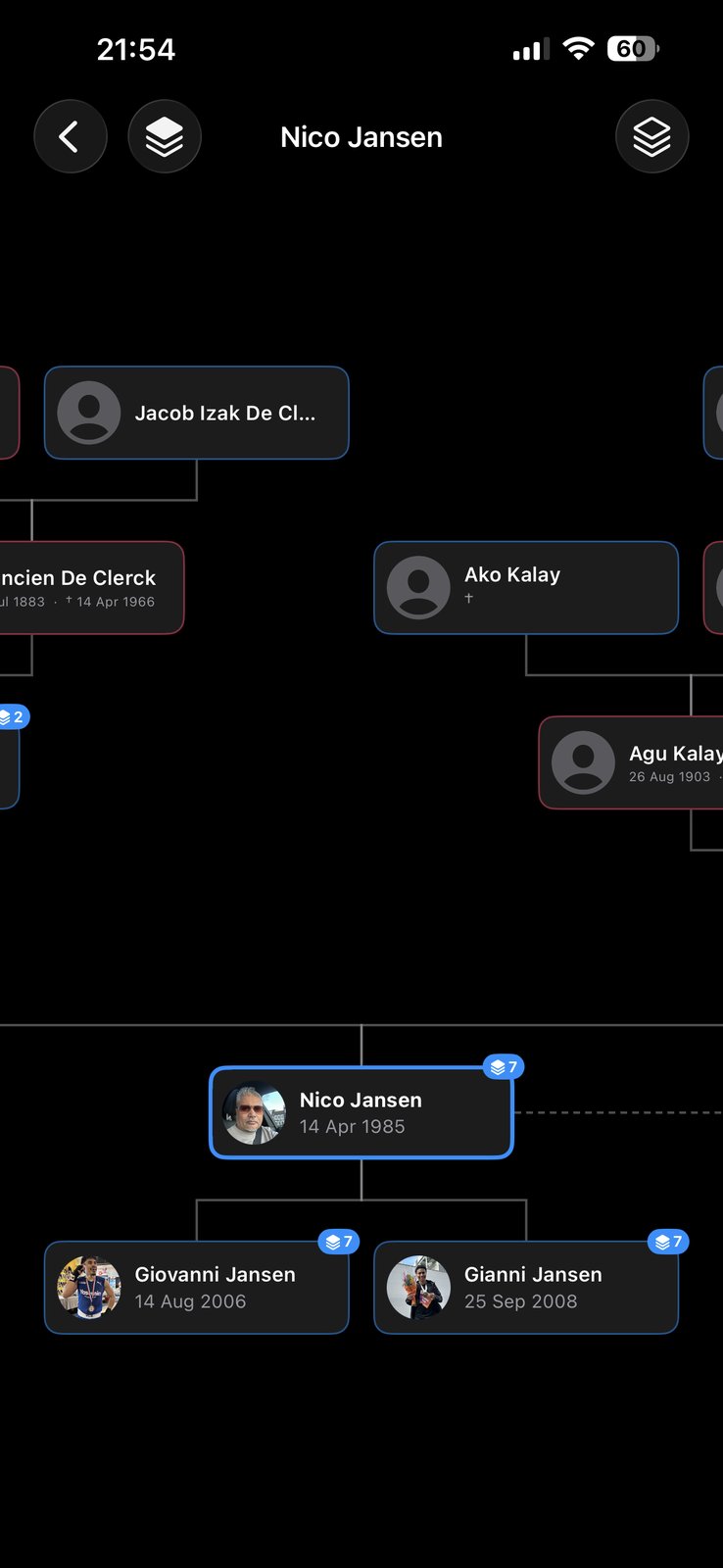
- A tree for each side. Keep a tree for your father’s family and one for your mother’s. When the same person appears in both, the All Trees view joins them into one chart, with both lines together.
- Shared with the family. Invite relatives to a tree through iCloud. Everyone can add what they know, and changes appear for all of them. The tree lives on your devices and in your own iCloud, visible only to the people you invite.
- Research with an assistant. Copy Summary puts a person’s family record, including your notes, on the clipboard. Paste it into an AI assistant and ask where to look further. Check every answer with your relatives or a source: oral tradition is not something an assistant can know.
- For the next gathering. Export the chart as an image or PDF, or stream it to an Apple TV, and show the family where every name comes from.
Gramps2 is in English, Dutch, German, French, Spanish, Italian and Brazilian Portuguese. It has no Indonesian or Malay interface, so Moluccan words like negeri and pela are simply what you type in.
Frequently asked questions
What does pela mean?
Pela is a traditional alliance between two or more villages (negeri) in the Central Moluccas, mainly on Ambon, the Lease islands (Haruku, Saparua, Nusalaut) and Seram. The people of allied villages see each other as brothers and sisters: they help each other, receive each other as family and keep the promise their ancestors made. The bond is inherited by every generation born into the village.
What is pela gandong?
Pela gandong is an alliance between villages that, according to their own tradition, descend from the same ancestors: often brothers who each founded a village. Gandong refers to the womb, so the villages count as children of one mother. People of gandong villages treat each other as siblings and traditionally may not marry each other.
Can you marry someone from your pela village?
Traditionally not, if the alliance is a pela keras or a pela gandong: the members count as brothers and sisters, so a marriage would be seen as incest, even without any proven blood relationship. In the lighter pela tempat sirih, marriage is usually allowed. Customs differ per village, so ask elders of both families before assuming either way.
Is pela passed down through the father or the mother?
In the Moluccas a child traditionally belongs to the father’s clan and village, so the pela of the father’s negeri is the one that counts. Many Moluccan families in the Netherlands also recognize the pela of the mother’s side, and sometimes of all four grandparents.
What is the difference between pela and gandong?
Pela in the strict sense comes from an event in the past, such as a war, a rescue or help with building a church or mosque, sealed with an oath or with betel. Gandong comes from shared descent: the villages see their founders as siblings. Gandong is often counted as one of the kinds of pela, but people also name it separately, as in the phrase pela gandong.
What is panas pela?
Panas pela, or bikin panas pela, means heating up the pela. It is a ceremony, sometimes lasting several days, in which the allied villages meet to renew the original oath, tell the story of how the alliance began, eat together, dance and make music, so that the youngest generation learns its obligations.
Can a Christian village and a Muslim village be pela?
Yes, and many are. Examples are Haria and Siri Sori Islam on Saparua, and the gandong of Booi, Aboru, Kariu and Hualoy. Allied villages help build each other’s churches and mosques, and after the violence that began in Ambon in 1999 the alliances were used to restore relations between communities.
Which app helps me record my Moluccan family tree on iPhone, iPad and Mac?
Gramps2 is a family tree builder for iPhone, iPad and Mac. Each person has places for birth and death and your own notes, which is where a negeri and its pela fit. You can keep a tree for each side of the family, attach photos and documents, and share a tree through iCloud with the family members you invite, who can add what they know.