Concerts · Checklist
What to Bring to a Concert: The Checklist for Your Ticket, Bag, Ears and the Way Home
Most lists of concert essentials start with sunscreen and a fan. This one starts with the thing that decides whether you get in at all: a ticket that opens when the network does not. Then the bag, your hearing, the timings and the last train home.
By Nico Jansen, maker of TixVault··15 min read
🇳🇱 Lees dit artikel in het Nederlands →🇩🇪 Diesen Artikel auf Deutsch lesen →🇫🇷 Lire cet article en français →🇪🇸 Leer este artículo en español →🇮🇹 Leggi questo articolo in italiano →🇵🇹 Ler este artigo em português (Portugal) →🇧🇷 Ler este artigo em português (Brasil) →
The short answer
For a concert you need your ticket ready on your phone without internet, a photo ID, a fully charged phone, a payment card, earplugs and at most one small bag that fits the venue’s rules. Read the venue’s page for that show the day before, because doors times, bag sizes and banned items differ per venue, and plan how you get home before you leave.
The seven steps:
- 1.Find out what kind of ticket you have
- 2.Get the ticket onto your phone so it opens offline
- 3.Read the venue’s page for that show
- 4.Pack light: ID, a charged phone, earplugs and a small bag
- 5.Plan the trip home before you leave
- 6.Agree on a meeting point that needs no signal
- 7.Open the ticket before you reach the door
You bought the tickets months ago. Since then the confirmation email has sunk under a few hundred newer ones, the PDF went to a Downloads folder, and the friend you are going with has no idea which seat is theirs. The night of the show starts with searching.
The things that go wrong at a concert are rarely about the music. A ticket that will not load at the door because twenty thousand phones share the same mobile cell. A backpack that is not allowed in, with no cloakroom left. Ears that ring for two days. A last train that left during the encore. Each of these is solved the day before, in ten minutes.
This is the checklist I would give a friend going to their first arena show, a club gig or a stadium tour. It works for any venue; where the rules differ, it says so and tells you where to look.
What should you bring to a concert?
You need six things for a concert: a ticket that opens without internet, a photo ID, a charged phone, a way to pay, earplugs, and a bag small enough for the venue’s rules. Everything else depends on the venue, the weather and whether you stand or sit.
| Bring | Why | Check beforehand |
|---|---|---|
| Your ticket, ready offline | No ticket, no entry; the network at the door is often overloaded | What kind of ticket it is and whether it opens in airplane mode |
| Photo ID | For alcohol, age limits and tickets issued in your name | Whether the ticket or the show has an ID or age rule |
| Phone, charged to 100% | Ticket, payment, photos and the way home all run on it | Whether the venue allows a small power bank |
| Bank card or phone payment | Many venues are cashless at the bars and the merch stand | The venue’s page for the show |
| Earplugs | A loud show can reach 100 decibels or more for hours | Nothing: they fit in any pocket |
| At most one small bag | Bag policies are strict and a cloakroom is not guaranteed | The maximum size, and whether bags must be clear |
For an outdoor show add a light rain jacket, sunscreen and a layer for after sunset; umbrellas are often banned because they block the view. For a long standing show, comfortable shoes you have worn before matter more than anything else on this list.
Leave at home whatever you would mind losing or handing in: large bags and backpacks, professional cameras with detachable lenses, glass, cans, aerosols, selfie sticks and food or drinks the venue does not allow. The exact list is on the venue’s website, usually under “bag policy”, “prohibited items” or “plan your visit”.
What kind of concert ticket do you have?
Concert tickets come in four kinds, a PDF or print-at-home ticket, a pass in Apple Wallet, a ticket inside the seller’s app, and a festival wristband, and each one is made ready in a different way. The difference that matters at the door is whether the barcode is fixed or keeps changing.
| Kind of ticket | Barcode | How to get it ready | Does a copy scan? |
|---|---|---|---|
| PDF or print-at-home ticket | Fixed | Save the file on your phone, or print it | Yes, a clear copy scans |
| Pass in Apple Wallet | Usually fixed | Add it to Wallet from the email or the seller’s site | Show the pass itself |
| Ticket in the seller’s app (Ticketmaster SafeTix, AXS Mobile ID) | Keeps changing every few seconds | Log in at home, update the app, open the ticket once | No, a screenshot does not scan |
| Festival wristband | A chip or code in the band | Exchange the e-ticket at the entrance, or wear the band that came by post | Only the band itself |
A PDF or print-at-home ticket
Smaller venues, club shows, theatres and many festivals send a PDF. The barcode is printed into the file and does not change, so the PDF on your phone, a printout or a clear image of it all work. The weak spot is where the file lives. A PDF that is still an attachment in your email may need the network to download at the moment you open it. Save it to the phone itself and open it once in airplane mode to be sure.
A ticket in the seller’s app
Most big arena and stadium tours now sell tickets that live inside the seller’s app. Ticketmaster calls them SafeTix, AXS calls them Mobile ID. The barcode on screen refreshes every few seconds, so a screenshot of it is useless, both to a tout and to you. You can only show the ticket in that app, on the phone of the account that holds it. Log in at home, install any update, open the ticket once so it is stored, and do not log out on the day. Many of these tickets can also be added to Apple Wallet from the app, which is often the fastest way through the door.
A festival wristband
At a festival the e-ticket is usually swapped for a wristband at the entrance, or the band arrives by post before the weekend. Once it is on, the band is your ticket: do not cut it off between days, and keep the e-ticket until the band is on your wrist.
I wrote a separate guide on getting a PDF ticket into Apple Wallet, including when a screenshot works and when it does not.
Will your ticket open without signal?
Your ticket only opens without signal if it is already stored on your phone, because the mobile network around a full arena or stadium is often overloaded in the hour before the show. The bars on your screen can look fine while nothing loads.
An arena holds fifteen to twenty thousand people, a stadium show several times that, and most of them arrive in the same hour holding a phone. Messages come in but do not go out; an email attachment spins. Some venues have their own Wi-Fi, many do not, and a queue outside the building rarely gets it.
So treat the network as absent at the door and prepare for that:
- The ticket must open without internet: a saved PDF, or an app ticket opened once at home.
- Take a screenshot of the venue map with your entrance and your section on it.
- Agree on a meeting point and a time instead of “I’ll text you when I’m there”.
- Keep the phone charged; searching for a signal drains the battery faster.
What bag can you take to a concert?
The bag you can take to a concert depends on the venue: many American arenas and stadiums allow only a clear bag plus a small clutch, many European venues allow a small bag of about A4 size, and some allow no bag at all. The rule can also change per show, so read the venue’s page for that night.
| Bag rule | Where you meet it | What fits |
|---|---|---|
| Clear-bag policy | Many arenas and stadiums in the United States | Typically one clear bag up to 12 × 6 × 12 inches, plus a small clutch about the size of a hand |
| Small bag only | Many European arenas and concert halls | Roughly A4 size; larger bags go to the cloakroom or are refused |
| No bags | Some stadium tours and some sold-out shows | What fits in your pockets |
| Backpacks with lockers | Many festivals | A small backpack is often allowed; lockers on site are usually extra and limited |
Do not count on a cloakroom. Some venues have one, some charge for it, and on a sold-out night it can be full before the support act. The fastest way through the bag check is to carry nothing that needs checking: phone, card, keys and ID in your pockets, earplugs in a coin pocket, and a small bag only if you need one.
Items that are often refused at the bag check:
- Professional cameras with detachable lenses, and video cameras (a phone camera is fine).
- Large power banks; a small one is often allowed, but check first.
- Glass, cans, aerosols and hard plastic bottles; some venues allow an empty soft bottle.
- Selfie sticks, umbrellas, chairs and anything that could be thrown.
- Outside food and drink, with exceptions for medical needs.
Do you need earplugs at a concert?
Yes, earplugs are worth bringing to any loud concert, because sound levels of around 100 decibels or more for a whole evening can damage your hearing for good. Ringing ears or muffled sound the next morning are a warning, not a souvenir.
In 2022 the World Health Organization published a standard for safe listening at venues and events. It uses 100 decibels as the upper limit for the average sound level and asks venues to monitor the sound and offer hearing protection. That limit is a ceiling, not a safe dose: a long show at that level is already a lot for your ears.
- Foam earplugs cost little, fit in any pocket and block a lot, but make the music sound dull.
- Music earplugs (often called high-fidelity or musicians’ earplugs) lower the volume more evenly, so the band still sounds like the band. They are reusable and come in a small case.
- Custom-made earplugs from a hearing specialist fit best and last for years, if you go to a lot of shows.
Children need more protection than adults: bring ear defenders for them rather than earplugs. And stand away from the speaker stacks; a few metres make a real difference.
Standing or seated: what changes?
A standing ticket means you choose your spot by when you arrive, so it rewards coming early, while a seated ticket has a fixed place and lets you arrive later. The checklist is the same; the timing and the comfort are not.
| Standing (general admission) | Seated | |
|---|---|---|
| Your spot | First come, first served | Fixed on the ticket: section, row, seat |
| When to arrive | Early, if you want to be near the stage | Around doors or during the support act |
| Bag | As small as possible; you hold it all night | A small bag fits under the seat |
| Leaving the floor | Often hard to get back to your spot | Easy, your seat waits |
| Shoes | Closed, comfortable, already worn in | Anything you like |
If you queue for a standing spot, eat before you join the queue, bring water if the venue allows an empty bottle to refill, and know where the toilets are before the floor fills up.
What time should you get to a concert?
For a seated ticket, arriving around the time the doors open or during the support act is usually enough; for a standing ticket near the stage, fans often queue hours before doors. The time printed on the ticket is usually the doors time, not the moment the headliner walks on.
A typical arena evening runs like this: doors open, a support act plays later, and the headliner starts after that, often an hour or more after the doors. Many venues publish the exact timings on their website or social media on the day of the show. If you want to see the support act, which is often worth it, plan for it.
| Ticket | Be at the entrance | Why |
|---|---|---|
| Seated, arena or theatre | Around doors, or during the support act | Security and the bag check take time |
| Standing, want to be near the stage | Hours before doors | The front is first come, first served |
| Standing, happy anywhere | Around doors | Queues are longest just before the headliner |
| Festival | Before the first act you want to see | Wristband exchange and bag checks at the gate |
Going together: who has which ticket?
When you go as a group, make sure every person has their own ticket on their own phone before you leave, so nobody depends on one phone, one battery or one signal at the door. The person who bought four tickets is often the one who is stuck in traffic.
- App tickets: transfer each ticket to the person using it with the transfer function in the seller’s app, a day or more before the show.
- PDF tickets: send each person the page with their seat, or keep the tickets in one shared place everyone has on their own phone.
- Write down who sits where. Four seats in one PDF look alike. Note which seat belongs to whom, so the right person shows the right code.
- Children: keep their tickets on your own phone and go through the door together.
Never post a picture of a ticket with a readable barcode before the show, not even in a group chat that might be forwarded. Whoever scans the code first gets in. More on this in my guide on how to share tickets with friends and family.
The concert checklist in 7 steps
Preparing for a concert takes seven steps: know your ticket, get it on your phone offline, read the venue’s page, pack light, plan the trip home, agree on a meeting point, and open the ticket before the door. The first five you do the day before; the last two on the way.
1. Find out what kind of ticket you have
Open the confirmation email. Is there a PDF attached, an “Add to Apple Wallet” button, a message that the ticket is in the seller’s app, or a note about a wristband? The ticket table above tells you what follows from it.
2. Get the ticket onto your phone so it opens offline
Save the PDF to the phone itself, or log in to the seller’s app and open the ticket once. Then switch on airplane mode and open it again. If it shows, you are done.
3. Read the venue’s page for that show
Find the doors time, your entrance, the bag policy, the cloakroom, the banned items and whether the venue is cashless. Check the age rule if you bring a teenager.
4. Pack light: ID, a charged phone, earplugs and a small bag
Put your ID and earplugs next to your keys the evening before. Charge the phone. Choose the smallest bag that fits the venue’s rules, or none.
5. Plan the trip home before you leave
Put the concert in your calendar with the venue as location and an alarm for when you need to leave, not for when the doors open. Look up the last train or bus. Shows with an encore often end later than the venue’s curfew suggests, and the queue for the station can take half an hour.
6. Agree on a meeting point that needs no signal
An entrance number, a sign, the merch stand. Agree on it before you leave, for before the show and for after it, and you will find each other when the phones stop working.
7. Open the ticket before you reach the door
While you queue, open the ticket, turn the brightness up and hold your ID with the phone. Hold the barcode flat and still under the scanner. You are in.
What goes wrong at the door, and what do you do?
Most problems at the door come from a ticket that will not load, a barcode the scanner cannot read, or a code that was already scanned, and most of them are solved at the box office near the entrance. Step out of the queue and ask; you are rarely the first that night.
| Problem | Likely cause | What to do |
|---|---|---|
| The ticket will not open | It still needs the network, or you were logged out of the app | Move away from the crowd, try the venue’s Wi-Fi if there is any, or go to the box office with your ID |
| The scanner does not read the code | Screen too dark, cracked, or a screen protector reflecting | Turn the brightness up, hold the phone flat and still, try a little further from the scanner |
| The scanner says “already used” | Someone else scanned a copy of the barcode first | Go to the box office with your ID and the purchase confirmation |
| A screenshot is refused | The ticket has a changing barcode that only works in the app | Open the ticket in the seller’s app, or ask the box office |
| Your bag is refused | Too big, or not clear at a clear-bag venue | Ask for the cloakroom or lockers; otherwise it goes back to the car |
After the encore: keep the night
After the show, keep the ticket and write down three things on the way home: who you were with, the song you will still be humming tomorrow, and the moment you will tell people about. In a few years that is what you will want back, and the ticket is the only thing that holds the date, the venue and your seat.
A PDF ticket stays with you as long as you keep the file. A ticket in the seller’s app may disappear from the app after the show, so take a screenshot beforehand if you want it as a keepsake; it will not scan, but it remembers. The setlist is usually online within a day on setlist.fm. I wrote a separate guide on keeping track of the concerts and games you have been to.
From inbox to front row with TixVault
I built TixVault because the search for a ticket always seemed to start at the door. It runs on iPhone and iPad. This is how it covers the steps above:
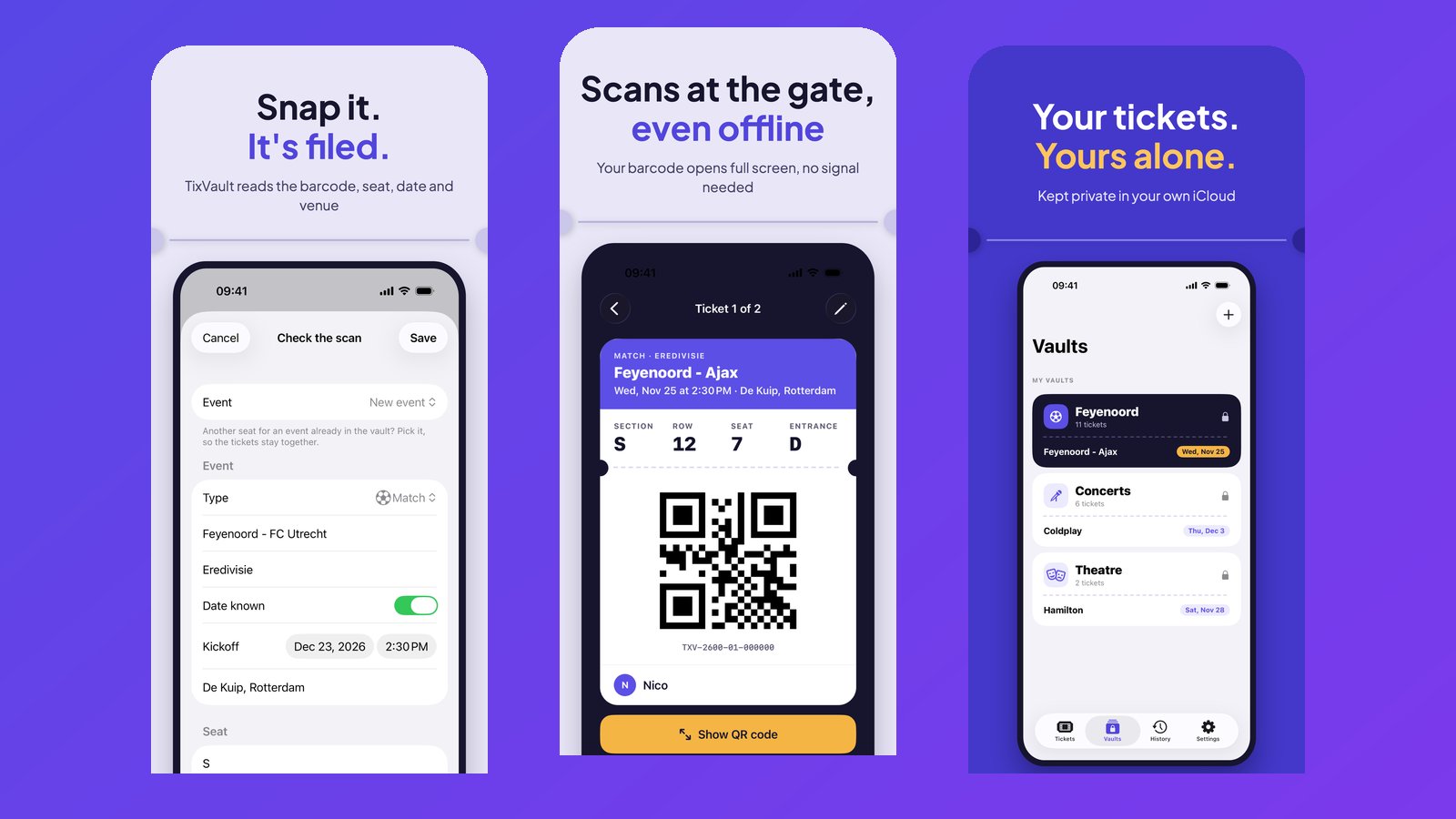
- One list, next show on top. Import the PDF from Files, a screenshot from Photos, or paste it from the clipboard. TixVault reads the event, date, venue, section, row, seat and entrance on the device, and you check the scan before it is saved. Pick concert, festival, theatre, match or other as the type.
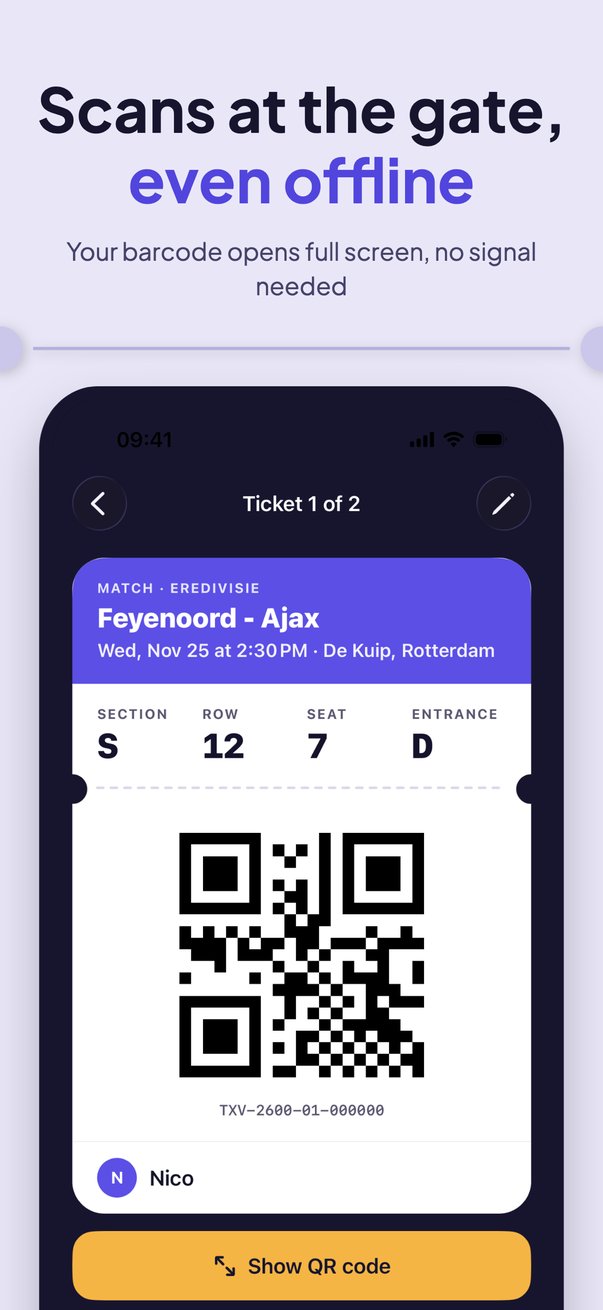
- Works without internet. The ticket, the barcode and the original file are stored on the device. Tap Show barcode and the screen goes to full brightness with nothing but the code. Airplane mode on, it still shows.
- The original, always. Show ticket displays the PDF or screenshot exactly as it was, pinch to zoom included, if someone at the door wants to see the whole ticket.
- Every seat, every guest, named. A PDF with four seats becomes one concert with four tickets, each with its own section, row, seat, entrance and the name of the person using it.
- In your calendar. One tap creates the calendar event with the venue as location and every seat in the notes, with an alarm beforehand and a reminder to leave in time.
- The whole group, one vault. Share a vault through iCloud, by invitation, and everyone in it has the same tickets on their own phone, offline, before anyone has to forward anything.
- The night afterwards. Three hours after the start the concert moves to History, where you write how it was and add your photos, grouped per year.
Your tickets are stored on your device and in your own iCloud account. There is no niApps account, there are no ads, and the ticket is read on the phone itself.
Where it does not fit: TixVault is for PDF and print-at-home tickets and screenshots of tickets with a fixed barcode. Tickets with a barcode that keeps changing inside the seller’s app, such as Ticketmaster SafeTix and AXS Mobile ID, cannot be stored by any other app as a working ticket; show those in the seller’s app. You can still import a screenshot of one as a keepsake for the diary. It runs on iPhone and iPad only, with no Android or web version.
Frequently asked questions
What should I bring to a concert?
Your ticket ready on your phone without needing internet, a photo ID, a fully charged phone, a payment card, earplugs and at most one small bag that fits the venue’s bag policy. Add a light layer for an outdoor show. Check the venue’s page for that show before you go, because bag sizes and banned items differ per venue.
Can I use a screenshot of my concert ticket?
Only if the barcode is fixed. A PDF or print-at-home ticket has a fixed barcode, so a clear copy scans. Tickets that live in the seller’s app, such as Ticketmaster SafeTix and AXS Mobile ID, use a barcode that keeps changing, and a screenshot of those will not get you in; show them in the app itself.
What if my phone has no signal at the venue?
Make sure your ticket does not need one. Save a PDF ticket on the phone itself, and open an app ticket once at home so it is stored on the device. With twenty thousand phones in one building the mobile network often struggles, so anything that still has to load can fail at the door.
What size bag can I take to a concert?
It depends on the venue. Many arenas and stadiums in the United States use a clear-bag policy, typically one clear bag up to 12 by 6 by 12 inches plus a small clutch. Many European venues allow a small bag of roughly A4 size and send larger bags to a cloakroom or refuse them. Some venues allow no bag at all. Check the venue’s own page.
Do I need earplugs at a concert?
It is a good idea. A loud concert is often around 100 decibels or more, and the World Health Organization’s 2022 standard for venues uses 100 decibels as the upper limit for the average sound level. Ringing ears afterwards are a warning sign. Earplugs made for music lower the volume without making the sound muffled.
What time should I get to a concert?
For seats, arriving around doors or during the support act is usually enough. For a standing ticket where you want to be near the stage, fans often queue hours before doors. In both cases check the venue’s timings on the day, because the headliner usually starts well after the doors open.
Do I need ID at a concert?
Often, yes. You need ID to buy alcohol, some tickets are issued in your name and checked against ID, and some shows have an age limit. Bring a passport, ID card or driving licence, and check the ticket and the venue’s page for the exact rule.
Which iPhone app keeps PDF concert tickets ready offline?
TixVault is a ticket wallet and event diary for iPhone and iPad. It imports a ticket as a PDF from Files, a screenshot from Photos or from the clipboard, reads the event, date, venue, section, row, seat and entrance on the device, and shows the barcode full screen without internet at the door. It can add the show to your calendar with a reminder, and vaults are shared with the people you go with through iCloud. It is for PDF and print-at-home tickets; barcodes that refresh inside an official ticketing app cannot be stored as a working ticket.