Genealogy · Family relationships
What Is a Second Cousin Once Removed? The Cousin Chart Explained
Second cousins, first cousins once removed, great-aunts and half cousins: family words sound harder than they are. Two small rules cover all of them, and one chart lets you look any of them up.
By Nico Jansen, maker of Gramps2··13 min read
🇳🇱 Lees dit artikel in het Nederlands →🇩🇪 Diesen Artikel auf Deutsch lesen →🇫🇷 Lire cet article en français →🇪🇸 Leer este artículo en español →🇮🇹 Leggi questo articolo in italiano →🇵🇹 Ler este artigo em português (Portugal) →🇧🇷 Ler este artigo em português (Brasil) →
The short answer
A second cousin once removed is the child of your second cousin, or the second cousin of one of your parents. The number says which ancestors you share: first cousins share grandparents, second cousins share great-grandparents. “Removed” says how many generations lie between the two of you.
To work out any relationship:
When my mother said we were “family of” someone, I could never quite picture how. A cousin of a cousin? An aunt by marriage? Years later, my own children asked me the very same questions, and I still couldn’t answer them.
It turns out the answer is always a small piece of arithmetic. Every blood relationship comes down to two things: which ancestors you share, and how many generations each of you is away from them. Once you see that, “second cousin once removed” stops being a riddle and becomes a description you can read.
This guide explains the two rules, gives you the chart to look relationships up, and covers the words around it: great-aunts, half cousins, in-laws, shared DNA and degrees of relationship.
What are first, second and third cousins?
Cousins are people who share an ancestor but do not descend from each other, and the number tells you how far back that shared ancestor is. First cousins share grandparents. Second cousins share great-grandparents. Third cousins share great-great-grandparents. Each step back adds one to the number.
Another way to see it: look at the generation above you. If your parents are siblings, you are first cousins. If your parents are first cousins, you are second cousins. If your parents are second cousins, you are third cousins. The children of cousins are always cousins one number higher.
| You are | The ancestors you share | In the generation above you |
|---|---|---|
| Siblings | Parents | The same parents |
| First cousins | Grandparents | Your parents are siblings |
| Second cousins | Great-grandparents | Your parents are first cousins |
| Third cousins | Great-great-grandparents | Your parents are second cousins |
| Fourth cousins | 3× great-grandparents | Your parents are third cousins |
A plain cousin, without “removed”, is always in the same generation as you. You are both the same number of steps away from the ancestors you share. That is the part people forget, and it is why the second rule exists.
What does “once removed” mean?
“Removed” means the two of you are in different generations, and the number says how many generations apart. Once removed is one generation, twice removed is two. The cousin number is taken from whichever of you is closer to the shared ancestors.
Take your first cousin. You share grandparents. Now move one generation on either side:
- One generation down. Your first cousin’s child is your first cousin once removed. Your grandparents are that child’s great-grandparents.
- One generation up. Your parent’s first cousin is also your first cousin once removed. Their grandparents are your great-grandparents.
So “first cousin once removed” covers two different people in your family, one older and one younger. The term works in both directions: if someone is your first cousin once removed, you are theirs.
The mistake almost everyone makes is to call a first cousin’s child a second cousin. They are not. Your cousin’s child is your first cousin once removed. Your child and your cousin’s child are second cousins.
A second cousin once removed follows the same pattern, one step further out: the child of your second cousin, or the second cousin of your father or mother.
The cousin chart
A cousin chart is a table that gives the name of a relationship from two facts: how each person descends from the ancestor they share. Find yourself in the first column and the other person in the top row. The cell where they meet is what that person is to you.
| You are the ancestor’s ↓ · They are the ancestor’s → | Child | Grandchild | Great-grandchild | 2× great-grandchild |
|---|---|---|---|---|
| Child | Sibling | Niece or nephew | Grandniece or grandnephew | Great-grandniece or -nephew |
| Grandchild | Aunt or uncle | First cousin | First cousin once removed | First cousin twice removed |
| Great-grandchild | Great-aunt or great-uncle | First cousin once removed | Second cousin | Second cousin once removed |
| 2× great-grandchild | Great-grandaunt or -uncle | First cousin twice removed | Second cousin once removed | Third cousin |
Read the diagonal from top left to bottom right and you get the same-generation relatives: sibling, first cousin, second cousin, third cousin. Every step away from the diagonal is one “removed”.
An example. Your great-grandparents are Anna and Willem. You are their great-grandchild, so you are in the third row. Someone else descends from them as a great-great-grandchild, the last column. The cell says second cousin once removed.
How to work out how you are related in 4 steps
You can name any cousin relationship by counting generations: the smaller count minus one is the cousin number, and the difference between the counts is the number of times removed. The chart stops at some point. The arithmetic doesn’t.
1. Find the ancestors you share
Look for the most recent ancestor, usually a couple, that both of you descend from. Most recent matters: you also share that couple’s parents, but counting from them gives the wrong answer. If you do not know who the shared ancestors are, this is where the research starts. Ask the oldest relative on each side who their grandparents were, and look for the same names.
2. Count the generations on both sides
Count the steps from yourself up to the shared ancestors. Your parents are 1 step, grandparents 2, great-grandparents 3, great-great-grandparents 4. Then do the same for the other person. You now have two numbers.
3. Take the smaller number and subtract one
That gives the cousin number. Smaller count 2: first cousins. Smaller count 3: second cousins. Smaller count 4: third cousins. If the smaller count is 1, one of you is a child of the shared ancestors, and you are in the sibling line: brother or sister, aunt or uncle, niece or nephew.
4. The difference is the number of times removed
Subtract the smaller count from the larger. Zero means you are in the same generation and there is nothing to add. One is once removed, two is twice removed.
| Your steps | Their steps | Smaller minus one | Difference | Relationship |
|---|---|---|---|---|
| 2 | 2 | 1 | 0 | First cousin |
| 2 | 3 | 1 | 1 | First cousin once removed |
| 3 | 3 | 2 | 0 | Second cousin |
| 3 | 4 | 2 | 1 | Second cousin once removed |
| 3 | 5 | 2 | 2 | Second cousin twice removed |
| 4 | 4 | 3 | 0 | Third cousin |
The hard part is rarely the counting. It is step 1: knowing who the shared ancestors are, and being sure of every link in between. That takes a family tree, on paper or in an app, where both lines are written down. If you have not started one, our guide on how to start a family tree walks through it.
Great-aunts, half cousins, in-laws and other terms
Outside the cousin chart, family words are built from a few prefixes: great- and grand- for generations, half- for one shared parent, step- and -in-law for relatives by marriage.
| Term | What it means |
|---|---|
| Great-aunt, great-uncle | The sister or brother of one of your grandparents. Also called grandaunt and granduncle. |
| Grandniece, grandnephew | The grandchild of your brother or sister. Also called great-niece and great-nephew. |
| Half sibling | A brother or sister with whom you share one parent instead of two. |
| Half first cousin | A cousin with whom you share one grandparent instead of two: your parents are half siblings. |
| Double first cousins | Cousins who share all four grandparents, because two siblings from one family married two siblings from another. |
| Step- | Related through a parent’s marriage, not by blood: stepfather, stepsister, stepchild. |
| -in-law | Related through your own marriage or a sibling’s: mother-in-law, brother-in-law. |
| Cousin by marriage | The husband or wife of your cousin, or the cousin of your husband or wife. Not a blood relative. |
Two notes on usage. In everyday speech people say great-aunt, and that is fine. In a family tree the word grandaunt is clearer, because the prefix then matches the generation: grandparents and grandaunts, great-grandparents and great-grandaunts. And in many families “aunt”, “uncle” and “cousin” are also used as terms of respect or affection for people who are more distant relatives, or no relatives at all. When an older relative calls someone a cousin, ask how. The answer is often the start of a new branch.
How much DNA do cousins share?
The amount of DNA you share with a blood relative roughly halves with every step between you: about 12.5% with a first cousin and about 3% with a second cousin. These are averages. Only the parent and child figure is fixed. For everyone else the real amount varies, because each child receives a random half of each parent’s DNA.
| Relationship | Shared DNA on average |
|---|---|
| Parent and child | 50% |
| Full siblings | 50% |
| Grandparent, aunt or uncle, half sibling | 25% |
| First cousin | 12.5% |
| First cousin once removed, half first cousin | 6.25% |
| Second cousin | 3.125% |
| Second cousin once removed | 1.56% |
| Third cousin | 0.78% |
This is why a DNA test cannot name a relationship by itself. Several relationships give the same average, and the ranges overlap. A match of around 6% may be a first cousin once removed, a half first cousin, or something else. With distant cousins the amounts get so small that two real third cousins sometimes share no detectable DNA at all. The test gives you a range of possibilities. The family tree tells you which one it is.
What is a degree of relationship?
A degree of relationship is a number that says how many steps of parent and child lie between two relatives. It is the language of law more than of family parties. Rules about inheritance, and about who may marry whom, are often written in degrees.
The most common way to count, the civil-law method, goes up from one person to the shared ancestor and down again to the other, counting every step. Parent and child are one step apart. Siblings are two: up to the parents, down to the sibling.
| Relationship | Degree (civil-law method) |
|---|---|
| Parent and child | 1st |
| Siblings, grandparent and grandchild | 2nd |
| Aunt or uncle and niece or nephew | 3rd |
| First cousins | 4th |
| First cousins once removed | 5th |
| Second cousins | 6th |
Be careful when you read an older document. Church law traditionally counted differently: only the steps on the longer of the two lines. By that count first cousins are related in the second degree, not the fourth. If an old marriage record mentions a dispensation for a certain degree, it is usually the church count. And if a degree matters for something legal today, look up how your own country’s law counts it.
Why other languages count differently
“Second cousin once removed” is an English way of counting, and other languages divide the family differently. That matters as soon as your family history crosses a border, because a word in an old letter may not mean what its English translation suggests.
Dutch, my own language, uses neef for both a nephew and a male cousin, and nicht for both a niece and a female cousin. Which one is meant, you have to work out from the ages. Spanish calls a second cousin primo segundo, and in Spain your parent’s first cousin is a tío segundo, a “second uncle”: the generation decides the word. German counts in grades, and a second cousin is a Cousin zweiten Grades.
So when a relative says someone is a cousin, an uncle or a neef, take the word as a hint and the tree as the answer. Find the shared ancestors, count the steps, and you know the relationship in any language.
From “family of” to a tree you can point at with Gramps2
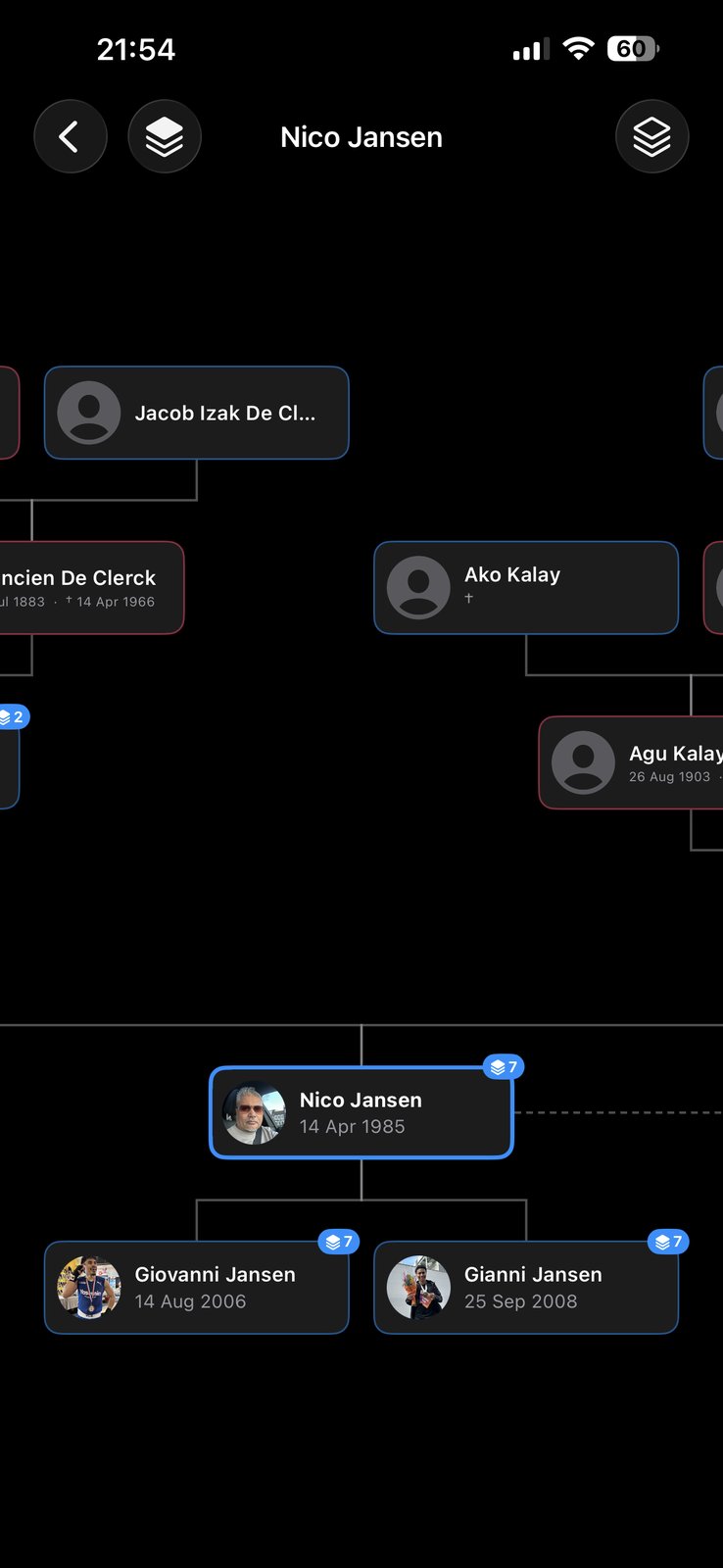
I built Gramps2 because of the question at the top of this article. It is a family tree builder for iPhone, iPad and Mac that makes the connections visible, so you can show how two people are related instead of explaining it:
- A chart you can wander through. Put anyone in focus, with ancestors above and descendants below. Pinch to zoom, drag to pan, and tap a relative to re-center the tree on them.
- Start from the shared ancestors. Put a great-grandparent in focus and the lines of descendants run down from them. In the Generations menu you choose how many generations of ancestors and of descendants the chart shows, up to six each way.
- Both sides of the family together. Keep a tree for each side. When the same person appears in more than one tree, the All Trees view joins them into one chart.
- Faces on the cards. Profile pictures and life dates sit on the chart, which helps when half the family shares a first name.
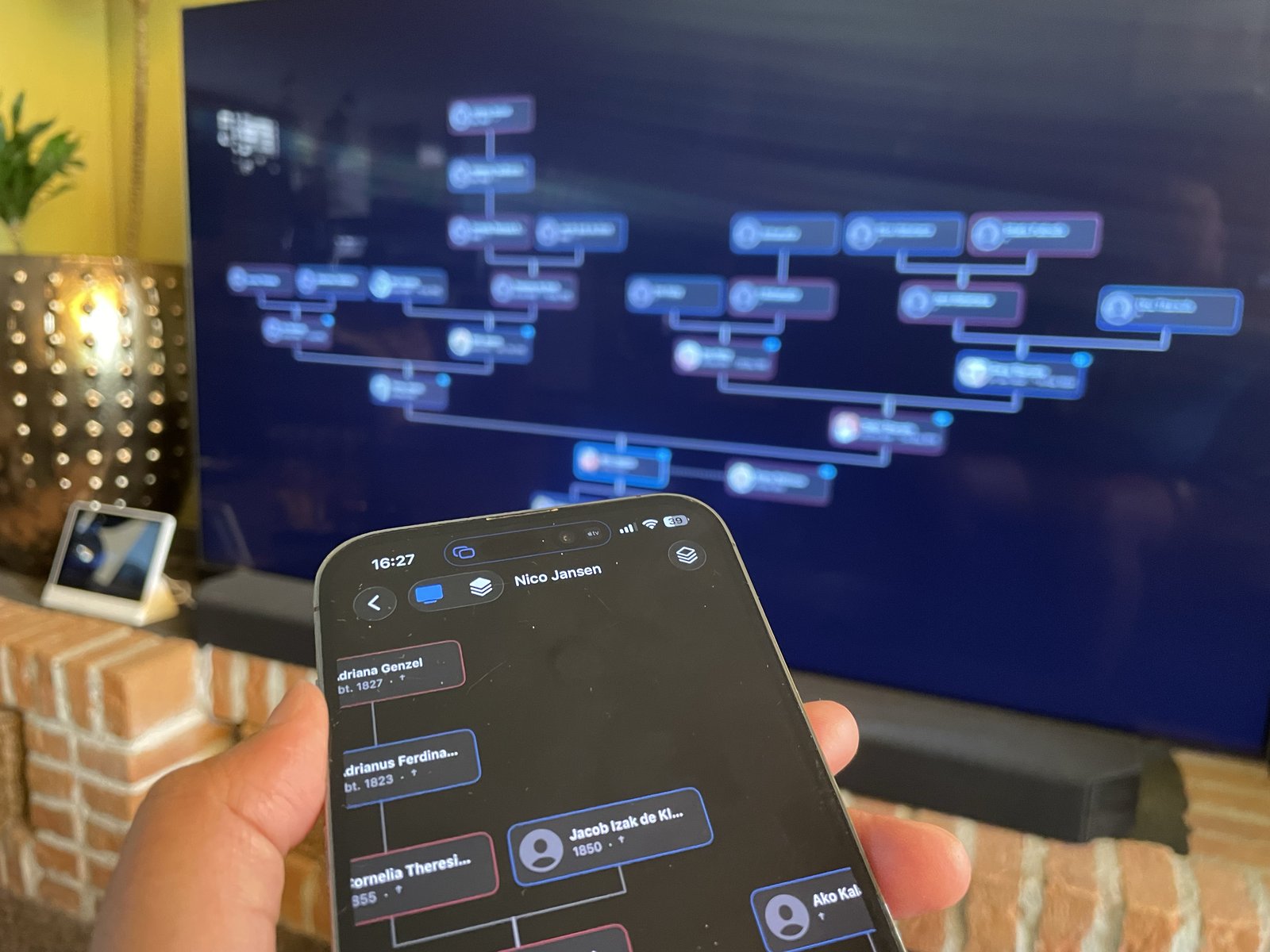
- On the big screen. Stream the chart to an Apple TV with AirPlay and settle the question with the whole family watching. Or export the chart as an image or PDF and send it round.
- Shared and private. Invite family members to a tree through iCloud. Your tree lives on your devices and in your own iCloud, visible only to the people you invite.
Frequently asked questions
What is a second cousin once removed?
A second cousin once removed is the child of your second cousin, or the second cousin of one of your parents. Second cousins share great-grandparents. “Once removed” means you are one generation apart, so the great-grandparents of one of you are the great-great-grandparents of the other.
What is the difference between a second cousin and a first cousin once removed?
A second cousin is in the same generation as you: your grandparents were siblings and you share great-grandparents. A first cousin once removed is one generation above or below you: the child of your first cousin, or the first cousin of your parent. People often call a first cousin once removed a second cousin, but they are different relationships.
What are my cousin’s children to me?
The children of your first cousin are your first cousins once removed. To your own children they are second cousins, because the two of them share great-grandparents: your grandparents.
What is my parent’s cousin to me?
Your parent’s first cousin is your first cousin once removed. The relationship has the same name in both directions: you are also their first cousin once removed. Their children are your second cousins.
What does twice removed mean?
Twice removed means two generations apart. Your first cousin twice removed is the grandchild of your first cousin, or the first cousin of one of your grandparents.
Are second cousins blood related?
Yes. Second cousins descend from the same great-grandparents. On average they share about 3% of their DNA, compared with about 12.5% for first cousins. A second cousin by marriage, the husband or wife of your second cousin, is not a blood relative.
Is it great-aunt or grandaunt?
Both mean the sister of one of your grandparents. Great-aunt is the everyday word. Genealogists often prefer grandaunt, because it keeps the prefixes in step with the generation: the sibling of a grandparent is a grandaunt or granduncle, and the sibling of a great-grandparent is a great-grandaunt or great-granduncle.
Which family tree app shows how relatives are connected on iPhone, iPad and Mac?
Gramps2 is a family tree builder for iPhone, iPad and Mac. Its chart puts any person in focus with ancestors above and descendants below, and you tap a relative to re-center the tree on them. Put a shared ancestor in focus and both lines of descendants are on screen. The tree is stored on your devices and in your own iCloud, and can be shared with the family members you invite.